
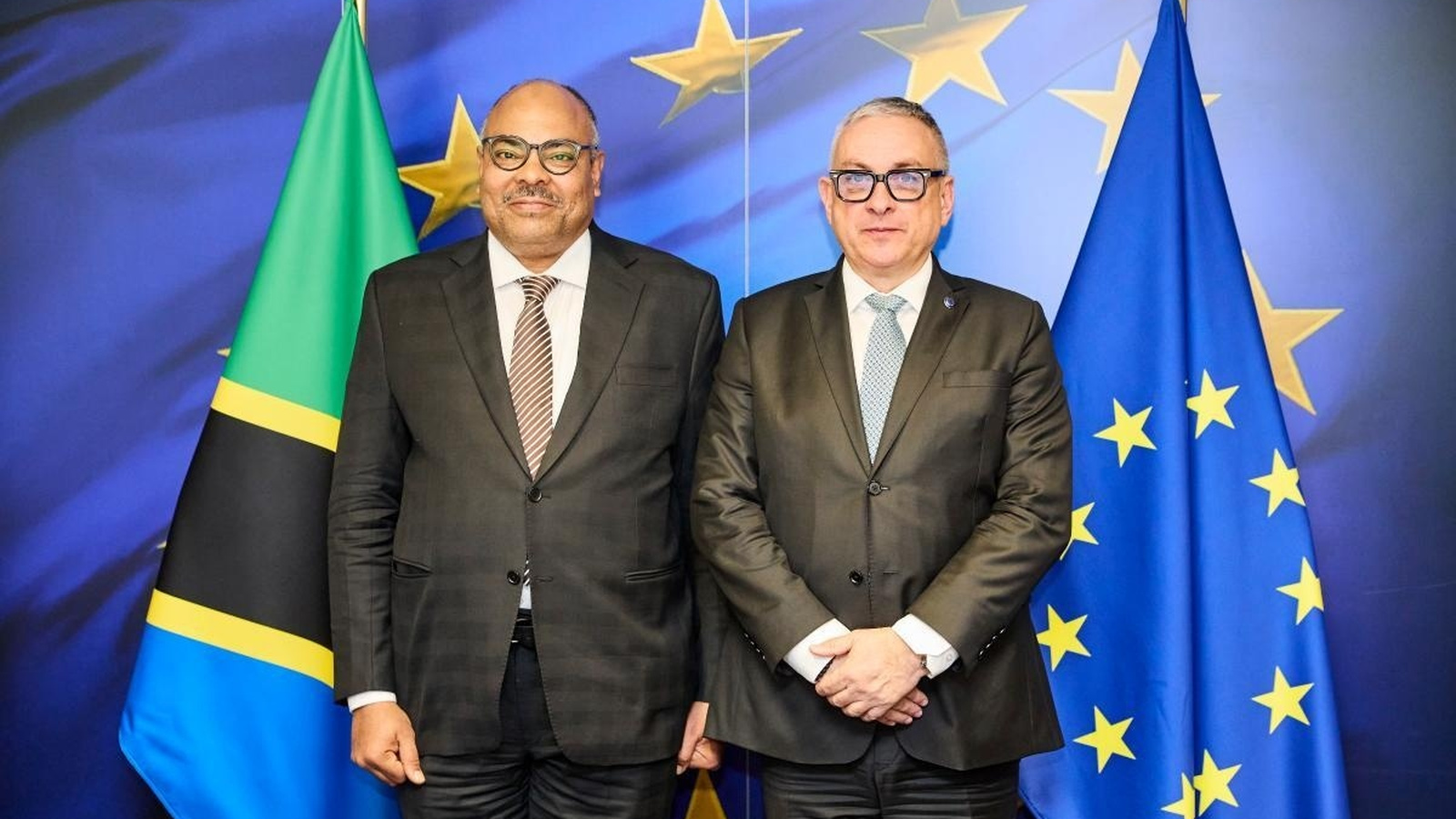
Executive capability snapshot
Tanzania's public record shows a substantial national digital-government foundation alongside increasingly visible foreign-affairs digital systems. The Ministry of Foreign Affairs and East African Cooperation has identifiable institutional functions for government communication, information and communication technology, policy and planning, diaspora engagement and economic-diplomacy-related work, while the ministry's public service environment includes systems such as the Foreign Management System, Diaspora Digital Hub and Diplomatic Recognition System. [5] [6] [7] [8] [9]
The wider national architecture is also significant. Tanzania's e-Government Strategy establishes connected-government, interoperability, cybersecurity, digital-service and institutional-capability objectives. The e-Government Authority's e-Government Capability Maturity Framework, version 1.1, was approved on 18 February 2026 and provides a seven-domain benchmark for measuring ICT maturity in public institutions. At the national level, the Tanzania National Artificial Intelligence Strategy Framework sets direction for AI governance, data governance and institutional capability, while the e-Government Authority published standards and guidelines for the management, implementation and responsible use of AI in public institutions on 4 September 2026. [13] [14] [15] [17]
The foreign-affairs record contains evidence not only of systems but of operational use and adaptation. The Diaspora Digital Hub was inaugurated in May 2023. In its 2026/27 budget speech, the Ministry reported that it had subsequently improved the system to increase the quality of diaspora information available for policy decisions, including removing unnecessary and ambiguous fields. By 14 May 2026, 3,065 diaspora users had registered. [10] [11]
A separate operational case demonstrates why digital infrastructure and institutional capability should be assessed separately. Tanzania's Controller and Auditor General reported that foreign missions had identified economic, trade, investment, technology-transfer and partnership opportunities, but that 50 Memoranda of Understanding forwarded to relevant government institutions between March 2022 and October 2025 remained pending during the audit review period. The same report recognised the Ministry's May 2025 launch of the Foreign Management System, integrated with the Prime Minister's Office and President's Office, while finding that timely review, response and follow-up of mission-generated opportunities and draft agreements remained incomplete. [12]
DD ANALYSIS
Tanzania therefore presents an important capability pattern: substantial digital-government infrastructure and clear foreign-policy ambition coexist with a documented need to strengthen the institutional pathways through which information generated abroad becomes owned, coordinated and acted upon across government. This profile treats that distinction as an institutional learning question rather than a technology deficit. [13] [12]
National digital-government capability is not treated as automatic evidence of foreign-ministry operating capability, and absence of public evidence is not treated as absence of capability.
Institutional signal map
| Dimension | Publicly visible signal | Evidence note |
|---|---|---|
| Institutional ownership | Developing | The Ministry has named Government Communication, Information and Communication Technology, Policy and Planning and Diaspora functions, alongside broader foreign-policy and economic-diplomacy responsibilities. Digital responsibilities are visible but distributed rather than presented publicly as a single ministry-wide digital-diplomacy operating function. [5] [6] [7] [8] |
| Strategy and doctrine | Developing | The 2024 Foreign Policy establishes economic diplomacy, diaspora participation, Kiswahili diplomacy and broader international priorities, while national e-government and AI frameworks provide enabling direction. A ministry-specific digital-diplomacy doctrine integrating missions, AI, data, communication and readiness is not publicly identified. [2] [13] [15] |
| AI governance in foreign affairs | Partially evidenced | National AI governance and public-sector responsible-AI standards are visible. Public sources reviewed do not establish an MFA-specific AI use-case inventory, approval structure, sensitive-data rules or human-review thresholds for diplomatic work. [15] [17] |
| Public diplomacy capability | Developing | The Government Communication Unit has explicit responsibility for communication strategy, media monitoring and analysis, public and media dialogue, publications and the ministry website. Diaspora engagement and the Foreign Policy's treatment of Kiswahili as an instrument of diplomacy add audience-facing capability. Public evidence of common audience-insight and learning standards across missions remains incomplete. [5] [8] [2] |
| Cyber and technology diplomacy | Partially evidenced | Tanzania is active internationally on AI, cybersecurity, digital public infrastructure, telecommunications and emerging technologies, primarily through the Ministry of Communication and Information Technology and specialised agencies. MFA participation is visible in some international engagements, but a dedicated MFA cyber/technology-diplomacy operating portfolio is not publicly established. [18] [19] |
| Mission-network capability | Partially evidenced | The national e-Government Strategy set a target of connecting 43 foreign missions to GovNet by June 2026. Public evidence reviewed through 7 October 2026 does not confirm completion of that target. [13] |
| Coordination and readiness | Partially evidenced | The Foreign Management System and cross-government interfaces provide coordination infrastructure. The 2024/25 CAG report documents a concrete follow-up and ownership challenge for mission-generated opportunities and draft MoUs. [12] |
| Sovereignty, continuity and human authority | Partially evidenced | National e-government, cybersecurity and AI frameworks contain relevant safeguards and governance requirements. MFA-specific continuity, AI authority, traceability and dependency controls are not fully visible in the public record. [13] [15] [17] |
The labels describe the public evidence available through 7 October 2026 for the scope stated in each row. National digital-government capability is distinguished from foreign-ministry practice; targets are distinguished from verified implementation; and the absence of public evidence does not establish absence of capability.
Institutional ownership
Tanzania's foreign-affairs institutional architecture is unusually useful for assessing ownership because several relevant functions are publicly named. The Ministry of Foreign Affairs and East African Cooperation formally represents Tanzania internationally and operates through a defined leadership and departmental structure. [4]
The Government Communication Unit has explicit responsibility for developing and implementing ministry communication strategies, coordinating media briefings, monitoring and analysing media, facilitating foreign media, engaging with the public and media, promoting ministry policies and programmes, preparing publications and maintaining current information on the ministry website. [5]
The Information Communication Technology Unit has a different mandate. It develops, maintains and reviews ministry ICT strategy and operations; enforces ICT standards; oversees coordinated and integrated management information systems; maintains hardware and software infrastructure; provides technical support and training; manages databases, websites, internet, intranet and webmail; and is explicitly responsible for electronic security of sensitive and critical ministry systems. [6]
The Policy and Planning Department adds a policy-conversion layer through strategic planning, annual planning, policy analysis, cabinet-paper liaison, research and coordination of Joint Permanent Commissions. The Diaspora Engagement and Opportunities Division separately owns diaspora policy coordination, database development, investment facilitation and engagement with government and non-state actors. [7] [8]
These are meaningful ownership signals. At the same time, the public record reviewed does not identify a single ministry-wide office or governance mechanism responsible for integrating communication, digital systems, AI, mission readiness, data governance and institutional learning into one digital-diplomacy operating model.
The Developing signal therefore reflects identifiable institutional ownership alongside distributed responsibility.
Strategy and doctrine
Tanzania's revised Tanzania Foreign Policy 2001 — 2024 Edition was launched in May 2025. The policy places economic diplomacy at the centre of foreign engagement and identifies additional priorities including peace and security, bilateral and multilateral cooperation, international treaties, diaspora participation, Kiswahili as an instrument of diplomacy, resource mobilisation, the blue economy, climate and environmental cooperation, gender and youth. [2] [1] [3]
The economic-diplomacy section explicitly includes trade, investment, technology transfer, skills and human-capital development, tourism and other forms of international economic engagement. Implementation is designed to involve multiple actors beyond the foreign ministry. [2]
DD ANALYSIS
This whole-of-government orientation is relevant to digital diplomacy because many international opportunities identified by missions require action outside the foreign ministry. It also increases the importance of clear ownership, response and escalation pathways once an opportunity crosses institutional boundaries. [2] [12]
National e-government and AI frameworks add a strong enabling layer, but they should not be presented as an MFA digital-diplomacy strategy. Public sources reviewed do not identify a ministry-specific doctrine defining common digital operating principles across headquarters and missions, AI-supported diplomatic work, mission data, digital public diplomacy, continuity or institutional learning.
Strategy and doctrine are therefore visible, but the digital foreign-affairs operating layer remains less publicly specified.
AI governance in foreign affairs
Tanzania has moved beyond a purely aspirational national AI discussion.
The Tanzania National Artificial Intelligence Strategy Framework, released in July 2025 by the Ministry of Communication and Information Technology, identifies responsible AI governance, human oversight, transparency, accountability, sector-specific AI governance, data sovereignty and institutional capacity as strategic concerns. [15]
The framework calls for sectoral AI governance frameworks, standards for inclusive and trustworthy AI systems, sectoral redress mechanisms and a national AI Observatory. It also calls for stronger sector-specific data governance and data-sovereignty arrangements. [15]
The strategy is particularly relevant to institutional capability because it identifies governance issues around AI deployment and public-sector use that require more than technical adoption alone. [15]
Implementation signals have since become visible. On 25 July 2026, the e-Government Authority reported that Msaada AI, Muhtasari AI and Tafsiri AI were in pilot development through its Research, Innovation and Development Centre. On 4 September 2026, e-GA listed Standards and Guidelines for the Management, Implementation and Responsible Use of Artificial Intelligence in Public Institutions. [16] [17]
These measures create a national governance environment relevant to the foreign ministry. The public record reviewed does not, however, establish how the Ministry of Foreign Affairs applies these requirements to diplomatic drafting, translation, policy analysis, public communication, consular work, negotiation or sensitive diplomatic information.
The foreign-affairs AI signal is therefore narrower than Tanzania's national AI-policy signal.
Public diplomacy capability
Tanzania has identifiable institutional infrastructure for public communication rather than only visible social-media activity.
The Ministry's Government Communication Unit is responsible for communication strategy, media briefings, media monitoring and analysis, dialogue with the public and media, promotion of ministry programmes and policies, publications and website information. This provides a direct ministry-level ownership signal for communication and media engagement. [5]
The revised Foreign Policy also identifies Kiswahili as an instrument of diplomacy, making language and cultural reach part of the country's formal external-engagement approach. [2]
Diaspora engagement provides a second public-facing capability. The Diaspora Engagement and Opportunities Division is responsible for policy coordination, maintaining diaspora data, investment engagement, public awareness and coordination with other institutions. The Diaspora Digital Hub extends this into a digital service and information environment. [8] [9] [11]
The evidence establishes organisational and channel capacity. What remains less visible publicly is a common mission-wide audience-research methodology, comparable engagement metrics, systematic feedback from posts into policy decisions or a documented learning cycle showing how public-diplomacy evidence changes practice across the network.
Public diplomacy is therefore assessed as an institutional capability with visible structure but incomplete public evidence of the full insight-to-learning cycle.
Cyber and technology diplomacy
Tanzania is visibly active in international technology governance, but public evidence places much of the formal ownership outside the foreign ministry.
In May 2026, Tanzania participated in the third United Nations Virtual Worlds Day in Geneva. The Ministry of Communication and Information Technology stated that Tanzania was serving as Vice-Chair of the executive committee of the Global Initiative on AI and Virtual Worlds and reported discussions with the International Telecommunication Union on emerging-technology governance, cybersecurity, spectrum management, innovation and digital public infrastructure. Tanzania's Permanent Representative in Geneva participated alongside the technology ministry and communications regulator. [18]
In July 2026, Tanzania and Brazil discussed cooperation in digital transformation, cybersecurity, artificial intelligence, data centres and digital public infrastructure, including continued cooperation through the International Telecommunication Union. [19]
These are material technology-diplomacy signals. They show the state using international organisations and bilateral relationships to pursue technology-policy objectives.
The institutional distinction remains important. The strongest public ownership evidence belongs to the Ministry of Communication and Information Technology and related agencies. The sources reviewed do not establish a dedicated cyber or technology-diplomacy portfolio inside the Ministry of Foreign Affairs comparable to foreign ministries that maintain a named cyber ambassador, technology envoy or dedicated cyber-diplomacy strategy.
The appropriate interpretation is therefore cross-government international technology engagement with partial evidence of a distinct foreign-ministry operating capability.
Mission-network capability
Tanzania's national digital-government planning explicitly includes the overseas diplomatic network.
The Tanzania e-Government Strategy 2022 set a target that 43 foreign missions abroad would be connected to the Government Communication Network, GovNet, by June 2026. This is a significant signal because overseas missions were included directly in national connected-government infrastructure planning rather than treated as institutionally separate from domestic public administration. [13]
Evidence discipline is important here. The strategy states a target. It does not itself establish that the target was completed.
A review of public material from the e-Government Authority, Ministry of Foreign Affairs and East African Cooperation and Ministry of Communication and Information Technology through 7 October 2026 did not identify an official public statement confirming that all 43 targeted foreign missions had been connected to GovNet.
The profile therefore does not state that all 43 missions are connected.
The Controller and Auditor General's 2024/25 report refers separately to 44 Foreign Missions for financial-audit purposes. This further demonstrates why the 43-mission GovNet target should not be interpreted as a current count of Tanzania's entire diplomatic network. [12]
The public record therefore supports a national intention to integrate foreign missions into common government infrastructure. It does not yet support a claim of verified GovNet completion, common post-level performance, redundancy, service availability or continuity across the entire mission network.
Capability in practice
From mission-generated opportunity to cross-government action
What happened?
The Controller and Auditor General reported that Tanzanian foreign missions identified economic, trade, investment, technology-transfer and partnership opportunities in host countries. The audit found that 50 Memoranda of Understanding forwarded to relevant government institutions between March 2022 and October 2025 remained pending during the review period. [12]
The report acknowledged the Ministry's launch of the Foreign Management System in May 2025, integrated with the Prime Minister's Office and President's Office to capture Memoranda of Understanding. It found, however, that the system had not yet ensured timely review, response and follow-up of opportunities and draft MoUs submitted by foreign missions during the audit period. [12]
Capability visible
Foreign missions are actively identifying opportunities; a digital management system exists; and interfaces with central government institutions have been established. [12]
What remains unresolved in the public record?
The audit identifies cross-government coordination, ownership and follow-up as the remaining institutional challenge during the period reviewed. Public sources reviewed do not establish the subsequent closure rate of the 50 pending cases or whether the recommended coordination mechanisms have since fully resolved the issue.
Transferable lesson
Digital systems can improve visibility and record management, but institutional conversion also depends on named ownership, response expectations, escalation and feedback across organisational boundaries.
Diaspora Digital Hub: deployment followed by improvement
What happened?
The Ministry reported that the Diaspora Digital Hub was inaugurated on 22 May 2023 to collect information on Tanzanians living abroad, including information relevant to engagement and services. [10]
In its 2026/27 budget speech, the Ministry reported that it had subsequently improved the system to increase the quality of diaspora information available for policy decisions. The changes included removing unnecessary and ambiguous fields. By 14 May 2026, 3,065 diaspora users had registered. [11]
Capability visible
A digital service moved beyond launch into operational use and subsequent modification. The Ministry explicitly connected data quality to better policy decisions. [11]
What remains unknown?
Public material does not establish registration coverage relative to the total diaspora population, common data-use practices across missions, engagement outcomes or the full feedback mechanism through which platform data changes policy.
Transferable lesson
Deployment is stronger evidence when followed by documented use and improvement. The Diaspora Digital Hub provides a visible example of Tanzania moving from system creation toward an iterative institutional-learning cycle.
GovNet and the overseas network
What happened?
The Tanzania e-Government Strategy set a target to connect 43 foreign missions abroad to GovNet by June 2026. [13]
Capability visible
Overseas missions were explicitly included in national connected-government infrastructure planning. [13]
What remains unknown?
The sources reviewed through 7 October 2026 do not provide public confirmation that all 43 targeted missions have been connected, nor do they provide mission-by-mission service availability, redundancy or continuity data.
Transferable lesson
Connectivity targets should be treated as targets until implementation evidence establishes completion. Mission-network readiness requires both infrastructure and evidence about operational performance.
From AI strategy to public-sector implementation
What happened?
Tanzania's National Artificial Intelligence Strategy Framework established a national AI governance direction. On 25 July 2026, the e-Government Authority reported Msaada AI, Muhtasari AI and Tafsiri AI in pilot development. On 4 September 2026, e-GA published Standards and Guidelines for the Management, Implementation and Responsible Use of Artificial Intelligence in Public Institutions. [15] [16] [17]
Capability visible:
Tanzania has moved from national AI strategy toward public-sector implementation, including pilot systems and responsible-use standards.
What remains unknown?
Public evidence reviewed does not establish how these requirements are operationalised specifically inside the Ministry of Foreign Affairs for diplomatic drafting, translation, analysis, public communication or sensitive information.
Transferable lesson:
National AI governance becomes foreign-affairs capability when cross-government standards are translated into ministry-specific workflows, data boundaries, decision rights and human oversight.
Cross-government technology diplomacy in Geneva
What happened?
In May 2026, Tanzania participated in the third United Nations Virtual Worlds Day in Geneva. The official record shows participation involving the Ministry of Communication and Information Technology, Tanzania's Permanent Representative in Geneva and the communications regulator in engagement covering AI, cybersecurity, emerging-technology governance and digital public infrastructure. [18]
Capability visible:
Tanzania can bring diplomatic representation and technical-policy actors together in international technology-governance engagement.
What remains unknown?
Public evidence does not establish whether this operates through a repeatable Ministry of Foreign Affairs technology-diplomacy model, common reporting routines or a dedicated MFA portfolio.
Transferable lesson:
Technology diplomacy can operate through distributed government ownership, but durable institutional capability depends on clear roles, coordination and continuity.
Readiness signals
Prepare
Developing
Scope: Revised foreign policy, named MFA institutional units, foreign-affairs digital systems, national e-government architecture and national AI governance; not a common published digital-diplomacy operating standard across every mission. [2] [5] [6] [13] [15]
Tanzania has substantial institutional and technological preparation. The remaining evidence question concerns how consistently national digital and AI frameworks are translated into foreign-affairs-specific practice.
Sense
Developing
Scope: Mission-generated economic opportunities, Government Communication Unit media monitoring and analysis, diaspora data and policy research; not a published common sensing methodology across all missions. [12] [5] [8] [7]
Foreign missions demonstrably identify opportunities abroad, while headquarters has communication-monitoring, research and diaspora-data functions. Public evidence of a standard network-wide process for combining, prioritising and preserving those signals is more limited.
Align
Partially evidenced
Scope: Foreign Management System and whole-of-government economic-diplomacy arrangements; not evidence that every cross-government workflow has defined ownership, deadlines and escalation. [12] [2]
The CAG finding provides unusually useful operational evidence: information was reaching relevant institutions, but coordinated follow-up remained incomplete in the reviewed cases. [12]
Respond
Partially evidenced
Scope: Digital foreign-affairs services, mission interfaces and cross-government systems; not a published, tested foreign-affairs response chain for high-pressure digital or information incidents.
Service and coordination infrastructure is visible. Public sources reviewed do not establish a common ministry-wide crisis-response standard covering missions, AI-supported workflows and digital disruption.
Recover
Limited public evidence
Scope: Foreign-affairs service restoration, mission fallback, data recovery, dependency continuity and post-incident review.
National e-government cybersecurity and continuity frameworks create an enabling environment, but public MFA-specific recovery targets, tested fallback arrangements and post-incident learning are not identified. [13]
Adapt
Developing
Scope: Documented improvement of the Diaspora Digital Hub, evolving national AI governance and ministry planning/review structures; not a complete published feedback-to-rule-change system across all foreign-affairs functions. [11] [17] [7]
The Diaspora Digital Hub provides concrete evidence that a deployed ministry system has been reviewed and changed. Public evidence of the same learning mechanism across the entire mission network remains incomplete. [11]
DD assessment
Institutional strengths
- Named ministry functions for communication, ICT, policy and planning and diaspora engagement. [5] [6] [7] [8]
- A revised foreign policy with a strong whole-of-government economic-diplomacy orientation. [2]
- Visible foreign-affairs digital systems, including the Foreign Management System and Diaspora Digital Hub, with the Diplomatic Recognition System also identified in the ministry's digital-service environment. [12] [9]
- Explicit inclusion of foreign missions in national connected-government planning. [13]
- National AI and e-government governance architecture relevant to foreign-affairs operations. [15] [17] [14]
- Independent audit evidence that allows institutional capability to be assessed beyond official announcements alone. [12]
- Evidence that the Diaspora Digital Hub progressed from deployment to documented improvement. [10] [11]
Structural tensions
- Digital responsibilities are institutionally distributed, while a single foreign-affairs digital operating model is not publicly identified.
- National AI governance is advancing faster than publicly visible MFA-specific AI governance. [15] [17]
- International cyber and technology engagement is visible, but much of its institutional ownership sits with the technology ministry and specialised agencies rather than a clearly defined MFA technology-diplomacy function. [18] [19]
- The Foreign Management System creates digital coordination infrastructure, while the CAG case shows that technology alone does not resolve ownership and response across ministries. [12]
- Mission connectivity is an explicit national objective, but completion of the 43-mission GovNet target is not publicly verified. [13]
Public evidence limitations
Public sources reviewed do not provide a complete account of:
- current GovNet connectivity for each Tanzanian foreign mission;
- ministry-wide AI use cases and approval controls;
- sensitive diplomatic-data handling for AI-supported work;
- common mission-level digital-readiness standards;
- audience-insight and public-diplomacy learning across posts;
- digital incident escalation and decision rights;
- service-recovery targets and tested mission fallback;
- vendor or platform dependency and exit arrangements;
- the post-audit disposition of the 50 pending MoUs identified by the Controller and Auditor General;
- a unified ministry-wide digital-diplomacy doctrine.
Transferable lessons
- Treat national digital-government maturity as an enabling layer, not as automatic proof of foreign-affairs capability.
- Separate connectivity targets from verified implementation.
- Assess the institutional chain after information reaches headquarters, not only whether missions can generate information.
- Use independent audit evidence to test whether digital systems translate into timely institutional action.
- Recognise improvement evidence: a system that is reviewed and changed provides stronger capability evidence than a launch announcement alone.
- Separate national technology diplomacy from ministry-specific ownership when different institutions lead the portfolio.
Methodology and limitations
This profile is based on publicly available material and assesses visible institutional arrangements and signals rather than confidential operational capability. It does not claim access to classified systems, non-public diplomatic workflows, internal decision records or ministry-wide tool inventories.
National digital-government strength is treated as an enabling condition rather than automatic evidence of foreign-ministry capability. A strategy or official target establishes intent; implementation requires separate evidence. An operational system establishes deployment; it does not by itself establish consistent institutional adoption, response or learning.
The GovNet assessment follows this rule specifically. Tanzania's e-Government Strategy set a target of connecting 43 foreign missions abroad by June 2026. No official source reviewed through 7 October 2026 was identified that publicly confirms completion of all 43 connections. The target is therefore reported as a target rather than an achieved result. [13]
The Controller and Auditor General's findings provide independent evidence of institutional practice during the audit period. They should not be interpreted as evidence that the identified conditions remain unchanged after that period. [12]
Limited public evidence does not indicate absence of capability.
DD interpretations are identified as analysis. Each substantive update is dated and summarised in the version history.
How to cite
Recommended citation
Iancu, Laura. “Tanzania Digital Diplomacy Capability Profile.” Diplomats.Digital, Digital Diplomacy Capability Profile 18, version 1.0, 2026.
APA
Iancu, L. (2026). Tanzania digital diplomacy capability profile (Version 1.0). Diplomats.Digital.
Chicago
Laura Iancu, “Tanzania Digital Diplomacy Capability Profile,” Digital Diplomacy Capability Profile 18, version 1.0 (Diplomats.Digital, 2026).
BibTeX
@misc{iancu2026tanzania_digital_diplomacy,
  author       = {Laura Iancu},
  title        = {Tanzania Digital Diplomacy Capability Profile},
  year         = {2026},
  publisher    = {Diplomats.Digital},
  howpublished = {Digital Diplomacy Capability Profile 18},
  note         = {Version 1.0},
  url          = {https://diplomats.digital/country-profiles/tanzania-digital-diplomacy}
}
Related DD knowledge
Sources reviewed
- Tanzania Foreign Policy — Ministry of Foreign Affairs and East African Cooperation
- Tanzania Foreign Policy 2001 (2024 Edition) — Ministry of Foreign Affairs and East African Cooperation
- Foreign Policy launch speech — Ministry of Foreign Affairs and East African Cooperation, 20 May 2025
- Management Team — Ministry of Foreign Affairs and East African Cooperation
- Government Communication Unit — Ministry of Foreign Affairs and East African Cooperation
- Information Communication Technology Unit — Ministry of Foreign Affairs and East African Cooperation
- Policy and Planning Department — Ministry of Foreign Affairs and East African Cooperation
- Diaspora Engagement and Opportunities Division — Ministry of Foreign Affairs and East African Cooperation
- Tanzania Diaspora services — Ministry of Foreign Affairs and East African Cooperation
- Budget Speech for the Financial Year 2023–2024 — Ministry of Foreign Affairs and East African Cooperation
- Budget Speech for FY 2026/27 — Ministry of Foreign Affairs and East African Cooperation
- Annual General Report for Audit of Central Government FY 2024/25 — National Audit Office of Tanzania
- Tanzania e-Government Strategy 2022 — e-Government Authority
- e-Government Capability Maturity Framework, Version 1.1, February 2026 — e-Government Authority
- Tanzania National Artificial Intelligence Strategy Framework — Ministry of Communication and Information Technology, July 2025
- e-GA Yaendeleza Ubunifu wa mifumo inayotumia Akili Unde — e-Government Authority, 25 July 2026
- Standards and Guidelines for the Management, Implementation and Responsible Use of AI in Public Institutions — e-Government Authority, published 4 September 2026
- Tanzania participates in the 3rd United Nations Virtual Worlds Day — Ministry of Communication and Information Technology, 12 May 2026
- Tanzania and Brazil strengthen cooperation on digital transformation — Ministry of Communication and Information Technology, 14 July 2026
Corrections and additional evidence
Submit a factual correction or additional official source through the Diplomats.Digital contact page.