
Strategic Communications in Foreign Affairs: From Messaging to Coordinated Institutional Action
Strategic communications is the institutional coordination of policy, evidence, timing, audiences, missions, leadership and response when communication has diplomatic consequence.
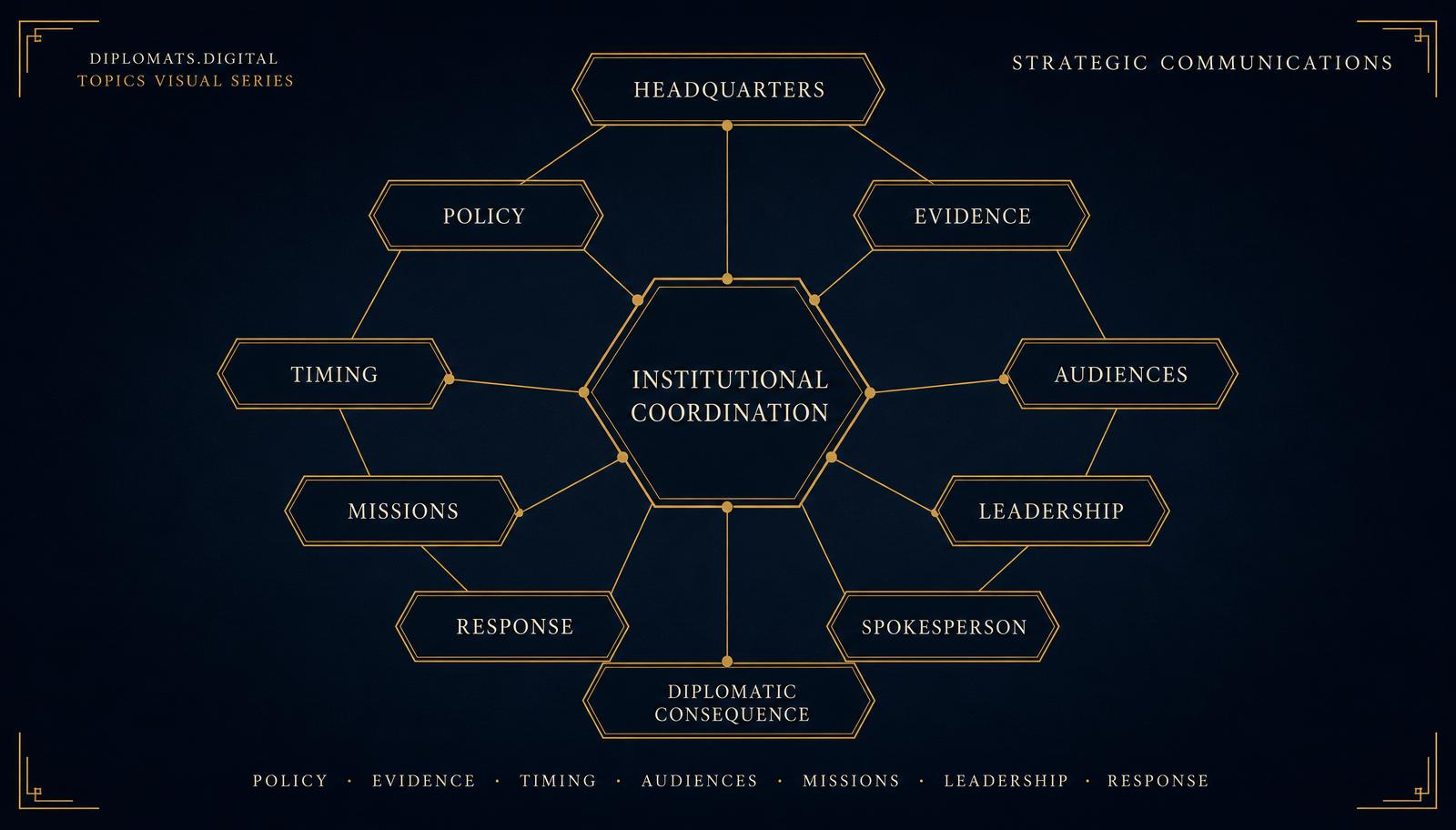
Why strategic communications begins with institutional coordination
How to use this article — a Diplomats.Digital guide to strategic communications as an institutional coordination function connecting policy, evidence, timing, audiences, missions, leadership and response. Read it to examine the operating chain behind communication that may carry diplomatic consequence.
- Foreign-affairs communication can affect bilateral relations, negotiations, public trust and crisis outcomes.
- A correct message can still fail when evidence, timing, leadership, policy and local context are not aligned.
- Synthetic media and rapid narrative movement compress the time available for verification and decision-making.
- Many apparent communication failures are underlying coordination failures across headquarters, missions and policy teams.
MoFA leadership, spokespersons, communications directors, policy and geographic teams, embassy leadership, crisis units, legal and security advisers, monitoring teams, AI-governance leads and institutional-readiness teams.
Can the institution coordinate policy, evidence, timing, audiences, missions and leadership quickly enough to act coherently when communication has diplomatic consequence?
What reading this helps you do
- Distinguish strategic communications from content production and message distribution.
- Identify the institutional chain required behind credible foreign-affairs communication.
- Assess readiness for mission–headquarters coordination, uncertainty, crisis response and synthetic-media incidents.
Key Insights
The message is only the visible output. Strategic communications is the institutional coordination behind it.
- 02
Communication coherence cannot be manufactured when the underlying policy position remains fragmented or unclear.
- 03
Speed matters, but verification, confidence levels and clear treatment of uncertainty protect institutional credibility.
- 04
Mission–headquarters alignment requires shared judgment and local adaptation, not identical language in every location.
- 05
Synthetic-media response is a verification, authority, escalation and coordination problem before it becomes a publishing problem.
Strategic communications is the institutional coordination of policy, evidence, timing, audiences, missions, leadership and response when communication has diplomatic consequence.
Communication with diplomatic consequence
Communication in foreign affairs can have immediate diplomatic consequences.
A statement may affect a bilateral relationship. A delayed response may allow an inaccurate narrative to become established. Different explanations from headquarters and an embassy may create confusion. An unsupported claim may damage trust long after the original event has passed.
For this reason, strategic communications cannot be treated only as the production and distribution of messages.
It is an institutional coordination function.
A working definition
Strategic communications in foreign affairs is the institutional coordination of policy, evidence, timing, audiences, missions, leadership and response when communication has diplomatic consequence.
This work connects several parts of a foreign ministry:
- policy teams;
- geographical departments;
- embassies and permanent missions;
- ministers and senior leadership;
- spokespersons and press teams;
- crisis-response structures;
- legal and security specialists;
- monitoring and analysis teams;
- digital and technical functions.
The communication product may be a speech, statement, briefing, interview, social media post, diplomatic démarche or decision to remain silent. Its effectiveness depends on the institutional chain behind it.
Policy coherence
Strategic communication begins with a clear understanding of policy.
Communication teams cannot create coherence when the underlying position remains fragmented, unclear or contested inside the institution. They need to know what has been decided, what remains under discussion and which elements cannot yet be made public.
A strong process distinguishes between:
- confirmed policy;
- working assumptions;
- diplomatic signals;
- factual evidence;
- legal constraints;
- operational details;
- political interpretation;
- information that remains uncertain.
This reduces the risk that temporary interpretations become public commitments.
Evidence and verification
Foreign affairs institutions increasingly communicate in environments shaped by manipulated media, incomplete information, automated content and rapid public speculation.
Speed matters, but speed without verification can produce larger problems.
Strategic communications therefore requires clear standards for:
- source verification;
- confidence levels;
- image and video authentication;
- translation accuracy;
- attribution;
- approval of factual claims;
- correction of errors;
- escalation of uncertain information.
During fast-moving events, the institution should be able to explain what it knows, what it does not yet know and what it is doing to establish the facts.
Uncertainty handled clearly can preserve credibility. Unsupported certainty can quickly damage it.
Timing
The right message delivered too late may have little effect.
The institution needs to understand when a situation requires immediate acknowledgement, when further verification is necessary and when public communication may create additional diplomatic risk.
Timing decisions should account for:
- operational developments;
- diplomatic negotiations;
- local time zones;
- activity at embassies and permanent missions;
- the speed of media reporting;
- the spread of contested narratives;
- leadership availability;
- partner and allied positions;
- possible effects on affected communities.
This requires shared situational awareness, not simply a faster publishing process.
Audiences and local context
Foreign affairs communication rarely has only one audience.
A single statement may be read by foreign governments, domestic citizens, international media, local communities in a host country, diaspora groups, partners, adversaries and diplomatic personnel.
These audiences do not interpret language in the same way.
Strategic communication needs a clear view of:
- who must understand the policy;
- who may be directly affected;
- who may misinterpret it;
- which local sensitivities matter;
- which languages and channels are appropriate;
- what level of detail each audience needs;
- how the communication may be reframed by others.
Embassies provide essential local context. Headquarters provides policy authority and a wider view of diplomatic consequences. The two must work together. See also public diplomacy as institutional relationship capacity.
Mission–headquarters alignment
Many communication failures are coordination failures.
An embassy may understand the local environment but lack timely guidance. Headquarters may hold the policy position but miss important local sensitivities. A mission may receive instructions after the narrative environment has already changed.
Mission–headquarters alignment requires more than sending approved talking points.
It involves:
- A shared understanding of the situation.
- Clear responsibility for verification and assessment.
- A defined route for local insight to reach headquarters.
- Timely policy guidance.
- Space for missions to adapt communication to local context.
- Clear approval and escalation thresholds.
- A record of decisions and lessons.
The objective is coordinated judgment, not identical language in every location. See Embassy Digital Transformation for the operational counterpart.
Leadership, spokesperson and policy coordination
Senior leaders, spokespersons and policy teams often operate under different pressures.
Leaders may need to signal intent. Spokespersons need accurate, defensible language. Policy teams need to protect negotiations and maintain consistency. Missions need guidance that works within the local diplomatic environment.
Strategic communications creates the process through which these requirements are reconciled.
Before significant communication, institutions should be able to establish:
- the policy objective;
- the evidence supporting the position;
- the diplomatic consequences;
- the audiences involved;
- the appropriate speaker;
- the timing;
- the level of public detail;
- the possible follow-up questions;
- the response if the situation changes.
Crisis and synthetic-media response
Synthetic audio, manipulated video and falsely attributed statements can create diplomatic pressure before institutions have established what happened. See also AI and Foreign Affairs.
A response process should determine:
- whether the content is authentic;
- who is circulating it;
- which audiences are being reached;
- whether the content is producing real-world consequences;
- whether public correction is necessary;
- who has authority to respond;
- how missions should communicate locally;
- what evidence can be released;
- how the incident should be documented.
Not every false item requires a public response. Some require monitoring, private engagement or coordination with partners. The decision should follow an established process rather than improvisation under pressure.
Strategic communication readiness
Institutional readiness can be assessed through practical questions:
- Can policy, communication and mission teams establish a shared picture quickly?
- Are factual claims traceable to verified evidence?
- Do missions know when they may respond and when they must escalate?
- Can local context change the communication approach?
- Are spokespersons briefed before an issue becomes public?
- Can the institution communicate clearly while facts remain incomplete?
- Are synthetic-media incidents covered by an operational protocol?
- Are decisions and approvals recorded?
- Can the institution correct an error without creating further confusion?
- Are lessons from previous crises integrated into future procedures?
Readiness depends on the quality of these connections across the institution. For related institutional context, see The Conversion Deficit and The Next Diplomatic Roles.
From messaging to coordinated action
Strategic communications becomes credible when policy, evidence, timing, leadership and institutional behaviour support the same direction.
The final message is only the visible part of the process.
Behind it should be an institution capable of understanding the situation, coordinating its people, making decisions under pressure and adapting when circumstances change.
In foreign affairs, communication has strategic value when the institution behind it can act coherently.
Selected institutional references
Institutional references and primary sources used to ground the article.
- NATO Strategic Communications Centre of ExcellencePublications and research on strategic communications
Alliance-level research on strategic communications discipline.
- NATO Allied Command TransformationStrategic Communications
Doctrine and capability development for coordinated strategic communications.
- NATONATO's approach to countering information threats
Official alliance framing on countering disinformation and information threats.
- NATOCommittee on Public Diplomacy
Institutional structure connecting public diplomacy and strategic communications.
- European External Action ServiceTackling disinformation
EU institutional approach to Foreign Information Manipulation and Interference (FIMI).
Future DD work in this area
This foundational guide establishes the institutional logic for future practical work across strategic communication readiness and diplomatic crisis coordination.
- 01Crisis Narrative Coordination ProtocolForthcoming
- 02Mission–HQ Coordination FrameworkForthcoming
- 03Strategic Communication Readiness AssessmentForthcoming
- 04Synthetic-Media Response ProtocolForthcoming
- 05Spokesperson–Mission–Policy Coordination ModelForthcoming
Narrative Resilience in Foreign Affairs
Why diplomatic institutions need institutional judgment, not only message control.
Read guideAI and Foreign Affairs: Beyond the Hype
Why AI in foreign affairs is a question of judgment, governance, and institutional capability.
Read guideEmbassy Digital Transformation
How missions become digitally enabled field nodes for coordination and public engagement.
Read guideThe Next Diplomatic Roles
Why MoFAs need more than tech ambassadors: a diplomatic role-architecture analysis.
Read guide