
Building Sovereign Diplomatic Capabilities: From Vendor Dependency to Institutional Control
Sovereign diplomatic capability is the institutional ability to retain meaningful authority over identities, data, workflows, decisions, AI functions, records, knowledge, and continuity supporting diplomatic action — across internally operated, managed, federated, shared, and externally accessed environments.
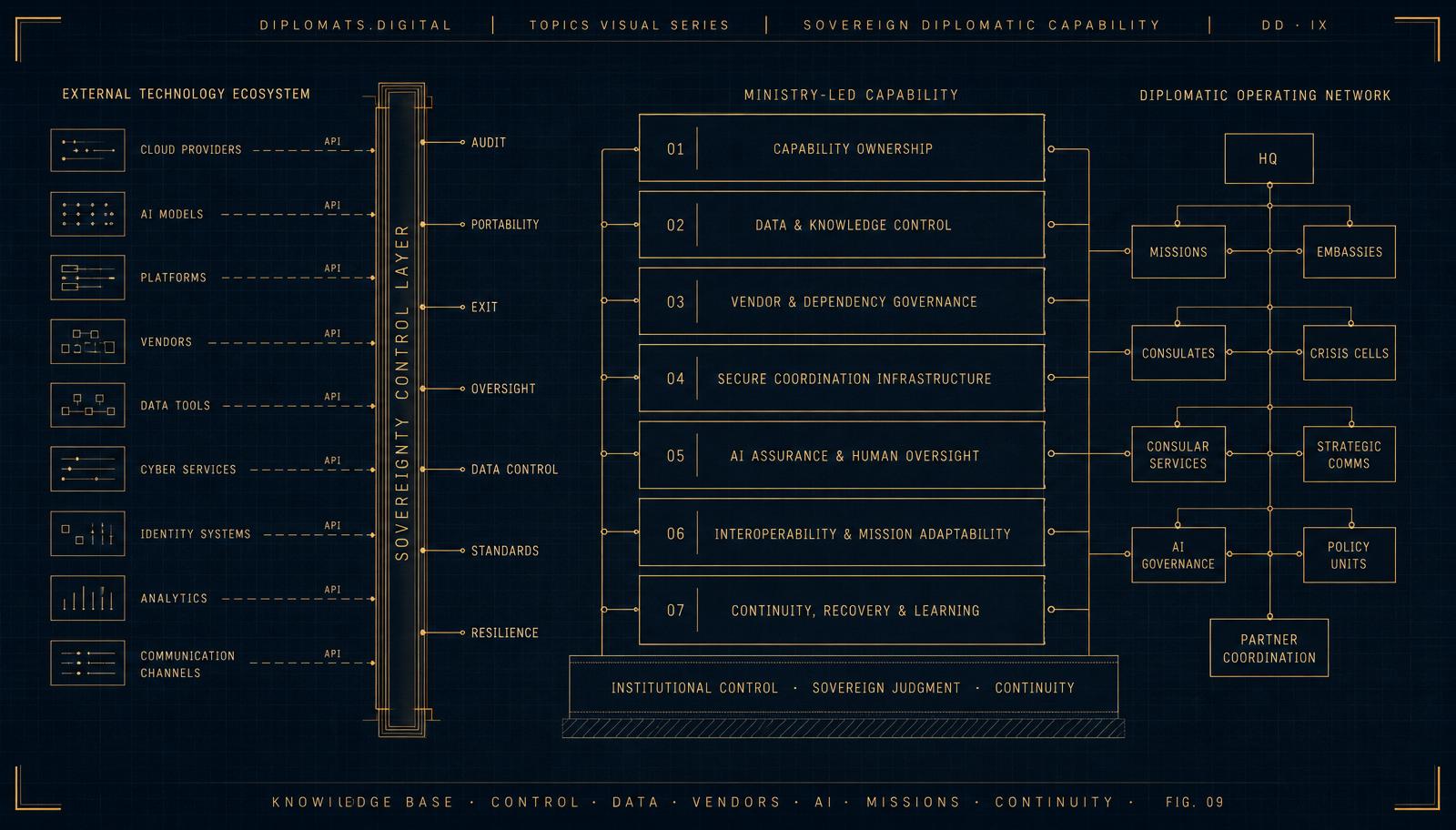
A strategic orientation for ministries building digital capability without losing institutional control
How to use this guide — a strategic orientation for understanding sovereign diplomatic capability as a practical institutional question. Read the brief for orientation; consult the framework, practical implications, leadership questions, and readiness check for diagnosis.
- Digital sovereignty is achieved through sovereign institutional capability, which becomes visible as operational sovereignty, AI sovereignty and identity sovereignty in infrastructure, identity, data, procurement, AI, interoperability, and continuity decisions.
- Authority is increasingly distributed across internal systems, external providers, national infrastructure, contracts, integrations, staff, and automated functions.
- Hosting location alone cannot establish whether an institution retains meaningful control over a capability.
- Agentic AI creates new questions about digital identity, delegated authority, permissions, traceability, accountability, and human control.
- Foreign ministries operate from different levels of technical, organisational, procurement, and security maturity, requiring several realistic implementation paths.
- Controlled experimentation allows ministries to test governance, dependency, continuity, and human oversight before wider deployment.
MoFA leadership, secretaries-general, CIOs, digital transformation units, diplomatic technology teams, cyber and information security leads, AI governance leads, consular directors, crisis response units, strategic communications teams, embassy leadership, procurement teams, legal advisers, policy planning units, and institutional reform teams.
How much meaningful authority does the ministry retain across the digital environment on which diplomatic work increasingly depends?
Three working definitions
These definitions provide a common institutional vocabulary for the guide.
- 01Definition
Digital sovereignty in foreign affairs
The capacity of a foreign ministry to choose, govern, audit, adapt, continue, and change the digital arrangements supporting diplomatic work.
- 02Definition
Sovereign diplomatic capability
The institutional ability to retain authority over critical identities, data, workflows, decisions, AI functions, records, knowledge, and continuity, regardless of which technologies or partners support them.
- 03Definition
Institutionally controlled implementation
An architecture, contract, partnership, or operating model that preserves meaningful institutional authority in proportion to the sensitivity and strategic importance of the capability involved.
What reading this helps you do
- Define sovereign diplomatic capability through retained institutional authority.
- Assess identity, traceability, continuity, interoperability, exit capacity, and AI oversight across internal, managed, federated, and hybrid environments.
- Select implementation and experimentation models suited to the ministry’s maturity, risk profile, mission network, and operational responsibilities.
Key Insights
Digital sovereignty is achieved through sovereign institutional capability: the authority an institution can exercise when systems, providers, personnel, or operating conditions change.
- 02
Foreign ministries can combine institution-operated, managed, federated, shared, and externally accessed capability within one coherent sovereignty strategy.
- 03
Hybrid environments can provide a responsible long-term architecture when responsibilities, dependencies, data flows, security requirements, and exit options remain visible and governable.
- 04
Open standards, self-hosting, portability, and federation can strengthen institutional choice. Their long-term value also depends on skills, governance, documentation, security, procurement, and technical support.
- 05
Controlled experimentation is a form of institutional learning. It allows ministries to test how authority, information, and responsibility move through a proposed system before deciding whether and how to scale it.
The Sovereign Diplomatic Capability Stack
Seven institutional layers foreign ministries can use to assess whether their digital systems, vendors, AI tools, and coordination workflows strengthen sovereign capability or quietly create dependency.
A ministry is not sovereign because it owns every tool. It is sovereign when it can govern the capabilities that matter.
- 01Layer I
Capability ownership
Clarifying which diplomatic functions are strategically critical and who owns them institutionally — crisis coordination, consular response, mission alignment, AI use, narrative resilience, secure communication, policy knowledge, digital identity, and diplomatic records.
Diagnostic questionWhich capabilities must remain under ministry governance regardless of which tools, vendors, or platforms support them?
- 02Layer II
Data and knowledge control
Ensuring that ministry data, diplomatic knowledge, institutional memory, crisis records, mission reporting, and analytical outputs remain accessible, protected, auditable, and portable.
Diagnostic questionCan the ministry access, move, understand, and govern its own data and knowledge without dependency on one vendor, system, or individual team?
- 03Layer III
Vendor and dependency governance
Managing external providers through clear standards, portability requirements, audit rights, exit options, continuity expectations, data protections, and role clarity.
Diagnostic questionDo procurement and partnership processes assess long-term dependency risk, or only immediate functionality and cost?
- 04Layer IV
Secure coordination infrastructure
Creating trusted channels and workflows for headquarters, embassies, consulates, crisis cells, policy units, and leadership to coordinate under normal and high-pressure conditions.
Diagnostic questionCan the ministry coordinate securely and coherently if public platforms, external tools, or informal channels become unreliable?
- 05Layer V
AI assurance and human oversight
Using AI in ways that preserve confidentiality, human judgment, accountability, transparency, and institutional responsibility.
Diagnostic questionAre AI tools governed through clear use cases, risk levels, approval rules, oversight, and human review — or are they spreading informally through individual experimentation?
- 06Layer VI
Interoperability and mission adaptability
Ensuring that systems can work across headquarters, large embassies, small missions, consulates, mobile teams, regional hubs, and partner environments without forcing one rigid model on all contexts.
Diagnostic questionCan the same capability logic adapt to different mission sizes, languages, legal contexts, risk profiles, and operational cultures?
- 07Layer VII
Continuity, recovery, and institutional learning
Designing systems so that the ministry can recover from disruption, preserve lessons, retain operational memory, and avoid losing capability when staff rotate or vendors change.
Diagnostic questionIf a tool fails, a vendor changes terms, a crisis escalates, or key staff rotate, does the ministry retain the capability — or only the memory that the tool once existed?
Sovereign diplomatic capability is the institutional ability to retain meaningful authority over the identities, data, workflows, decisions, AI functions, records, knowledge, and continuity that support diplomatic action — regardless of which technologies, providers, or partners operate them. It does not require building everything internally, nor does it prevent working with external providers. It requires that ministries can govern, adapt, audit, recover, and change course across the digital environment on which diplomatic work increasingly depends.
Sovereignty is not isolation
Digital sovereignty is often misunderstood.
It can sound like a call to disconnect from global technology markets, reject external providers, or build national alternatives for everything.
That is not realistic for most foreign ministries. It is also not desirable.
Diplomacy depends on connection. Foreign ministries need global communication tools, interoperable systems, trusted providers, cross-border standards, secure cloud services, AI capabilities, cybersecurity expertise, crisis platforms, and external technical knowledge.
The question is not whether ministries should work with external technology partners.
They already do, and they will continue to.
The question is whether those partnerships strengthen or weaken the ministry’s ability to act as a sovereign institution.
The European Commission’s Sovereign Cloud Framework describes sovereignty in cloud procurement through objectives linked to security, compliance, values-based adoption, resilience, and public-sector control. France’s Ministry for Europe and Foreign Affairs similarly frames digital transformation around sovereign missions, secure trade and data, influence, crisis management applications, and services for citizens abroad.
For foreign ministries, this logic becomes very practical:
Can the ministry govern the systems it relies on?
Can it change provider if needed?
Can it recover during disruption?
Can it protect sensitive diplomatic data?
Can it audit AI-assisted outputs?
Can it preserve institutional knowledge?
Can it adapt tools to local mission realities?
Can it explain who is accountable when digital systems affect diplomatic action?
Sovereignty is not ownership of everything.
It is governability of what matters.
Why capability matters more than tools
The easiest version of digital transformation is tool adoption.
A ministry buys a platform.
A team launches a dashboard.
A unit adopts an AI assistant.
A mission uses a social listening tool.
A consular service deploys a new interface.
A crisis team creates a secure channel.
A communications team monitors online narratives.
Each tool may be useful.
But tools do not automatically become institutional capability.
A tool becomes capability only when it is connected to people, governance, workflows, training, oversight, continuity, and decision-making.
The OECD’s work on digital public infrastructure is useful here because it defines DPI as shared, secure, and interoperable digital systems that support services at scale and reduce duplication across government. The lesson for diplomacy is not that every ministry needs national-scale DPI for foreign affairs. The lesson is that digital capability should be built as shared institutional infrastructure, not as isolated project activity.
A foreign ministry can have many tools and still be institutionally fragmented.
It can also have fewer tools but stronger capability if those tools are well-governed, interoperable, trusted, and embedded in real workflows.
The maturity question is therefore not:
How many digital systems do we have?
It is:
Which institutional capabilities do those systems actually strengthen?
The hidden risk of fragmented digitalization
Fragmentation is one of the quietest risks in diplomatic modernization.
It rarely appears as a crisis at first.
It appears as a series of reasonable decisions.
One team buys a monitoring tool.
Another uses a different analytics provider.
A mission creates its own workaround.
A crisis unit relies on messaging groups.
A consular team uses a separate database.
A policy unit stores knowledge in shared drives.
A communications team keeps approval flows in email.
An AI tool is tested informally by individual officers.
A vendor becomes indispensable because no internal alternative exists.
None of this is necessarily irresponsible.
Often, it reflects necessity. Ministries are under pressure, budgets are limited, crises move quickly, and teams need practical solutions.
But over time, fragmented digitalization can produce institutional dependency.
The ministry may lose visibility over what tools are being used.
Data may become hard to retrieve.
Workflows may become impossible to audit.
AI use may spread without governance.
Missions may operate with different standards.
Knowledge may remain trapped in platforms, inboxes, or individuals.
Vendor decisions may become harder to reverse.
The risk is not that ministries use external systems.
The risk is that the institution no longer knows where its operational capability actually lives.
Three types of dependency
Sovereign diplomatic capability requires a more precise vocabulary for dependency.
Not all dependency is the same.
01 · Vendor dependency
This occurs when a ministry becomes too reliant on one provider for a critical function, especially when data portability, exit planning, audit rights, contractual transparency, or continuity protections are weak.
Vendor dependency is not always visible at the start. It often appears later, when switching becomes difficult.
02 · Workflow dependency
This occurs when the way work is done becomes shaped by a tool rather than by diplomatic purpose.
A dashboard may define what leadership sees.
A platform may determine what counts as relevant.
An approval tool may slow down crisis response.
A vendor interface may reshape how missions report.
A social listening tool may privilege measurable signals over diplomatic judgment.
Workflow dependency is subtle because it looks like efficiency.
But if the tool begins to define the work, the ministry may lose control over its own operating logic.
03 · Model dependency
This is increasingly important in the AI era.
Model dependency occurs when foreign ministries rely on AI systems whose training data, assumptions, limitations, security posture, jurisdictional exposure, update cycles, and output behavior are not sufficiently understood or governed.
The OECD identifies governance, data, digital infrastructure, skills, investment, procurement, and partnerships as core enablers for trustworthy AI in government. The Council of Europe’s Framework Convention on Artificial Intelligence also anchors AI governance in human rights, democracy, and the rule of law across the lifecycle of AI systems.
For diplomacy, model dependency is not only a technical problem.
It is a judgment problem.
If AI summarizes diplomatic reporting, suggests response options, classifies public sentiment, translates sensitive language, or assists crisis triage, then the ministry must understand how human oversight, source reliability, bias, confidentiality, and accountability are managed.
AI and the sovereignty of judgment
AI in foreign affairs introduces a new kind of sovereignty question.
Not only: Where is the data stored?
Not only: Who owns the infrastructure?
Not only: Which vendor provides the tool?
But also:
Who shapes the interpretation?
Diplomacy depends on judgment. That judgment is built from context, history, nuance, language, political sensitivity, legal constraints, human relationships, institutional memory, and national interest.
AI can support that work.
It can help summarize, translate, search, classify, draft, compare, detect, retrieve, and organize.
But it should not silently become the layer through which diplomatic reality is interpreted.
The EU AI Act entered into force in August 2024 and uses a risk-based approach, including transparency requirements for certain AI-generated content and deepfakes. The UN Global Digital Compact also recognizes the need to identify and mitigate risks from emerging technologies and ensure human oversight.
For foreign ministries, this means AI governance cannot be treated as an IT policy alone.
It is an institutional doctrine issue.
Which AI uses are allowed?
Which are restricted?
Which are prohibited?
Which require human review?
Which require secure environments?
Which require source traceability?
Which are appropriate for public material but not sensitive diplomatic work?
Which outputs can be used in policy analysis, consular triage, crisis communication, or leadership briefing?
An AI posture designed to preserve retained authority does not block experimentation.
It creates boundaries that make experimentation institutionally safe.
The diplomacy-specific problem
Many digital transformation models are designed for generic public administration.
Foreign ministries are different.
They operate across borders.
They manage confidential relationships.
They serve citizens abroad.
They coordinate missions in very different local environments.
They negotiate in sensitive contexts.
They communicate publicly and privately.
They handle crises under uncertainty.
They represent the state symbolically and operationally.
They rely on locally engaged staff, diplomatic rotations, secure channels, and political trust.
A tool designed for ordinary public-sector productivity may not be suitable for diplomatic work.
A tool designed for corporate communications may not understand diplomatic escalation risk.
A tool designed for domestic citizen services may not work for consular emergencies across jurisdictions.
A generic AI assistant may not be appropriate for sensitive diplomatic context.
A monitoring platform may detect online signals but miss local meaning.
This is why sovereign diplomatic capability must be institutionally aligned.
It must fit the ministry’s legal obligations, security posture, diplomatic culture, mission network, crisis routines, and tolerance for risk.
The purpose is not to make diplomacy more “tech-like.”
The purpose is to make diplomatic institutions more capable under digital conditions. This is where diplomatic technology and Foreign Affairs Innovation intersect: not as add-ons to policy, but as the operating layer beneath it.
External partners are not the problem
An institutionally controlled approach should not become anti-vendor.
That would be a mistake.
Most foreign ministries will need external partners. They will need cybersecurity companies, cloud providers, AI vendors, digital identity specialists, data governance experts, crisis technology providers, communication platforms, research institutions, advisory partners, and implementation support.
The strongest model is not ministry versus vendor.
It is ministry-led capability with external support.
External partners should strengthen the institution’s ability to govern, not make the institution dependent on them.
This means good partners should support:
- knowledge transfer,
- documentation,
- interoperability,
- exit planning,
- training,
- internal ownership,
- auditability,
- modular architecture,
- sovereign data handling,
- and adaptation to ministry culture.
This is also where a capability-building approach differs from a platform-selling approach.
A platform asks:
Will you adopt our system?
A capability approach asks:
What does your institution need to be able to do — safely, coherently, and sustainably?
That distinction matters. Purpose-built environments such as DiplomatIQ exist to rehearse exactly this kind of capability logic under realistic institutional pressure.
Smaller and mid-sized states need a pragmatic model
Capability designed to preserve retained authority is especially important for smaller and mid-sized states.
Large states may have bigger budgets, larger technical teams, national cloud strategies, internal AI labs, cyber commands, and stronger procurement leverage.
Smaller and mid-sized states often face a different reality.
They need advanced capability but may not be able to build everything themselves.
They need security but may have limited internal capacity.
They need AI access but cannot fully inspect every model.
They need modern consular systems but cannot sustain large custom platforms.
They need narrative awareness but cannot maintain large monitoring teams.
They need mission coordination but operate with small posts and stretched staff.
This makes dependency risk sharper.
But it also makes modular capability more valuable.
A pragmatic model does not say: build everything internally.
It says:
- define the capability clearly;
- retain ownership of doctrine and governance;
- use external support where useful;
- avoid single-point dependency;
- require portability and auditability;
- train internal owners;
- design for small missions as well as headquarters;
- keep diplomatic judgment inside the institution.
World Bank GovTech work is useful because it treats public-sector digital transformation as a maturity question across core government systems, service delivery, citizen engagement, and enabling conditions. For foreign ministries, a similar maturity logic can help smaller and mid-sized states strengthen capability progressively, without pretending they must immediately build large-scale systems alone.
Stress tests, not failure stories
Sovereign capability becomes visible under stress.
A crisis reveals whether consular systems can scale.
An outage reveals whether workflows can continue.
A vendor change reveals whether data is portable.
A deepfake reveals whether verification routines exist.
A platform shift reveals whether public communication is over-dependent.
A cyber incident reveals whether recovery plans are real.
A staff rotation reveals whether knowledge is institutional or personal.
These are not failure stories.
They are stress tests.
The 2024 CrowdStrike-related outage was not a hostile cyberattack, but CISA described it as a widespread outage affecting Microsoft Windows hosts due to an issue with a CrowdStrike update. For foreign ministries, the broader lesson is that operational resilience must include third-party failure, software update risk, manual fallback, communication continuity, and recovery procedures.
Similarly, ENISA’s public administration threat landscape points to data breaches, data leaks, ransomware, and availability-related threats affecting public administration entities. For diplomatic institutions, this reinforces the need to treat sovereignty as resilience: the ability to continue, recover, and preserve trust when systems are pressured.
What should remain sovereign?
Not every system needs the same level of control.
A public newsletter tool does not require the same controls as a crisis coordination system.
A public website does not require the same controls as classified diplomatic reporting.
A social media analytics tool does not require the same controls as consular identity infrastructure.
A generic AI writing assistant does not require the same controls as an AI system used for sensitive briefing material.
The key is classification.
Foreign ministries need to classify digital capabilities by strategic importance, sensitivity, dependency risk, and continuity requirement.
A practical classification might include:
01 · Public-facing low-sensitivity tools
Useful tools for communication, publication, outreach, and basic analytics.
02 · Operational support tools
Systems that support routine workflows but do not carry highly sensitive diplomatic material.
03 · Mission-critical coordination systems
Tools used for crisis response, mission alignment, consular escalation, leadership briefing, and secure coordination.
04 · Sovereign institutional systems
Capabilities that involve sensitive data, diplomatic judgment, national position, AI governance, identity, secure records, institutional memory, or continuity of diplomatic action.
The stronger the capability, the stronger the governance requirement. This is also where the future MoFA agenda meets sovereignty: institutional readiness depends on which capabilities the ministry has chosen to govern deliberately.
From procurement to capability design
Procurement often asks useful but incomplete questions:
What does the tool cost?
What features does it offer?
Who else uses it?
How fast can it be deployed?
Is it compliant?
Is it secure?
Can it integrate?
Sovereign capability design asks additional questions:
What institutional function does this strengthen?
Who owns the capability after deployment?
What data does it generate?
Can that data be exported?
Can the workflow continue if the vendor fails?
What assumptions does the system encode?
Can missions adapt it to local conditions?
What training is required?
What risks does AI introduce?
What happens when staff rotate?
What is the exit plan?
How will lessons be retained?
This does not make procurement slower for the sake of caution.
It makes procurement more strategic.
A ministry should not only buy tools.
It should design capabilities.
Toward modular sovereign capability
The best model for many foreign ministries is modular.
A modular capability architecture allows ministries to combine internal systems, external tools, national infrastructure, trusted vendors, open standards, secure environments, and mission-specific adaptations.
Modularity matters because foreign ministries are not uniform institutions.
Headquarters has different needs from a small embassy.
A consular crisis has different needs from cultural diplomacy.
A mission in a high-risk information environment has different needs from a low-risk context.
A public diplomacy team has different needs from a cyber diplomacy desk.
A senior leadership briefing has different needs from routine monitoring.
Modular capability allows the ministry to avoid both extremes:
- one rigid central system that does not fit local realities;
- many disconnected tools that create fragmentation.
The goal is a shared institutional logic with adaptable implementation.
This is the middle path that preserves institutional control and retained authority.
From modularity to retained authority
A modular architecture makes sovereign capability possible; it does not, by itself, make it real.
Modularity determines how components can be arranged. Retained authority determines what the ministry can still decide, govern, audit, adapt, and recover when those components change.
The remaining sections translate this shift — from architecture to authority — into a practical test, a set of implementation paths, and a model for institutional experimentation.
The Retained Authority Test
The Retained Authority Test is a lightweight diagnostic for assessing whether the ministry retains meaningful authority over a given capability — a platform, workflow, AI function, data flow, or vendor arrangement. It applies equally to internally operated, managed, federated, shared, and externally accessed environments.
The test examines five dimensions:
- Identity and delegated authority. Can the ministry establish who or what is acting across the capability, under whose authority, and within which limits? This includes staff, service accounts, integrations, and AI agents.
- Data and knowledge continuity. Can the ministry access, understand, export, and reuse the data, records, configurations, and institutional knowledge held within or produced by the capability?
- Traceability and accountability. Can important actions, decisions, sources, model outputs, and automated interventions be reconstructed and reviewed after the fact?
- Interoperability and portability. Can the capability be moved, replaced, adapted, or interconnected with other systems without loss of function, records, or governance?
- Continuity and recovery. Can essential work continue — and can the ministry recover the capability — if the provider, contract, integration, or key staff become unavailable?
A capability that passes on identity but fails on portability is not sovereign. A capability hosted internally that lacks traceability is not sovereign. Sovereignty is judged by the pattern across all five dimensions, not by any single control.
Institutionally controlled implementation paths
Ministries operate from different levels of maturity, budget, technical capacity, procurement flexibility, and legal constraint. A single implementation model cannot fit every institution, capability, or mission context.
The following five paths describe realistic options that preserve institutional control and retained authority. Most ministries will use several in combination.
- Self-hosted institutional capability. Systems operated inside ministry infrastructure or a trusted national environment, with direct control over configuration, access, updates, data, and recovery. Appropriate for the most sensitive functions where the ministry has, or intends to build, the required competence.
- Managed sovereign capability. Systems operated by a qualified national or trusted partner under contractual and legal arrangements that preserve institutional authority, auditability, portability, and exit. Suitable when internal operation is not feasible but governance designed to preserve retained authority is required.
- Federated national capability. Independently governed instances that interoperate through shared standards, allowing ministries, agencies, and missions to collaborate while retaining local control over data, identity, and configuration.
- Public-cloud sovereign capability. Use of commercial cloud environments configured for public-sector sovereignty requirements — location, encryption, key management, access controls, transparency, and contractual safeguards — for capabilities where such arrangements are proportionate to sensitivity.
- Hybrid capability. A deliberate combination of the above, where each capability is placed in the environment that best matches its sensitivity, criticality, cost profile, and continuity requirements. Hybrid architectures require clear responsibility mapping, visible dependencies, and defined exit options.
None of these paths is inherently sovereign or non-sovereign. Sovereignty depends on how the arrangement is governed, documented, monitored, and made changeable over time.
Distributed ministry scenario
Scenario — a distributed ministry. A mid-sized foreign ministry operates from headquarters, a regional hub, and a network of embassies and consulates of varying size. Its core diplomatic records and crisis coordination run on a self-hosted institutional platform. Consular case management uses a managed sovereign service provided by a national partner. Public diplomacy and cultural teams collaborate across missions through a federated instance shared with cultural institutes. Analytical AI functions run on a public-cloud sovereign configuration with strict data boundaries and human review. Legacy correspondence, protocol tools, and shared reference materials remain in a hybrid environment while migration decisions are prepared.
No single component defines whether this ministry is sovereign. What defines sovereignty is whether identity, data, traceability, portability, and continuity remain governable across the whole arrangement — and whether the ministry can change any element without losing capability.
Open-source and federated capability
Open standards, self-hosting, portability, and federation are institutional options that can strengthen sovereign capability when they are matched with skills, governance, security, procurement, and long-term support.
They allow ministries to choose where systems run, to move data and configurations between environments, and to collaborate across independently governed instances without depending on a single provider. As a reference point, published materials from open platforms such as Nextcloud Hub 26 Winter describe operational features — data export and import, migration between instances, and decentralised collaboration — that illustrate how open standards can support portability in practice. Nextcloud’s materials on federation further describe federated collaboration between independently controlled environments as a way to reduce dependence on any single provider. These references are provided as practical illustrations and do not constitute an endorsement of any specific product.
Open and federated approaches are not inherently more sovereign than commercial arrangements. Their value depends on how they are governed, secured, documented, staffed, and maintained over time.
Experimentation as institutional learning
Sovereign capability is not adopted in a single decision. It is developed through repeated cycles of scoped experimentation in which the ministry learns how authority, information, and responsibility move through a proposed system before it is scaled.
A responsible experimentation model has six steps:
- 1. Frame the capability. Define the diplomatic function under examination, the sensitivity of the information involved, and the institutional decisions that depend on it.
- 2. Design a bounded pilot. Limit the pilot to a defined use case, user group, dataset, timeframe, and mission environment. Bounded scope makes learning possible.
- 3. Apply the Retained Authority Test. Assess identity, data continuity, traceability, portability, and recovery before the pilot begins, and again during operation.
- 4. Operate with human oversight. Ensure that responsible officials can observe, question, correct, restrict, or halt automated or AI-enabled functions during the pilot.
- 5. Review evidence, not impressions. Evaluate the pilot against pre-agreed criteria — dependency, security, workload, quality, continuity, cost, staff experience — rather than general enthusiasm or discomfort.
- 6. Decide the next step. Scale, adapt, replace, or discontinue the capability. Document the reasoning so that institutional learning survives staff rotation and subsequent decisions.
Experimentation understood in this way is not a technology exercise. It is a disciplined institutional practice for building sovereign capability under real conditions.
Five institutional signals, five lessons
- 01United Kingdom implication
Sovereignty at capability level
The UK Parliament’s science-diplomacy report recommends applying own–collaborate–access decisions to specific capabilities within technology stacks. Lesson for foreign affairs: sovereignty strategies become actionable when ministries identify which components require direct control, structured collaboration, or safeguarded external access.
- 02ITU implication
Identity now includes AI agents
The ITU’s work on trust and identity for humans and agentic AI brings permissions, authentication, accountability, interoperability, and lifecycle assurance into the same standards discussion. Lesson for foreign affairs: institutions need to know who or what is acting, under whose authority, and with which limits.
- 03United Nations implication
AI governance requires implementation capacity
The UN Global Dialogue on AI Governance places capacity-building, access, interoperability, transparency, accountability, and human oversight within one international governance agenda. Lesson for foreign affairs: ministries need internal competence alongside diplomatic positions on global AI governance.
- 04Australia implication
Cross-government coordination belongs near the centre
Australia established an Office of AI within the Department of the Prime Minister and Cabinet to coordinate work across government. Lesson for foreign affairs: AI governance increasingly crosses departmental boundaries and requires institutional coordination beyond isolated technical teams.
- 05Public-sector sovereignty implication
Exit capacity is strategic capacity
The House of Lords Library’s analysis connects digital sovereignty with infrastructure, standards, data, market concentration, foreign dependency, vendor lock-in, and open technologies. Lesson for foreign affairs: an institution’s ability to move, adapt, and change course is part of its operational resilience.
Leadership Questions
A reflection set for senior diplomatic leadership, digital transformation teams, CIOs, and institutional reform units.
- 01
How much meaningful authority does the ministry retain across the digital environment supporting diplomatic work?
- 02
Can we establish who or what is acting across our systems, under whose authority, and within which limits?
- 03
Can important decisions, sources, system changes, and automated interventions be reconstructed?
- 04
Can essential work continue if a provider, integration, contract, key employee, or connected service becomes unavailable?
- 05
Can our data, records, configurations, and institutional knowledge move when a system or provider changes?
- 06
Which AI-enabled functions operate inside the ministry, what information do they access, and who can restrict or disable them?
- 07
Which capability components should we operate directly, where should we collaborate, and where is controlled external access appropriate?
- 08
Where do hybrid arrangements obscure responsibility, dependency, security requirements, or exit options?
- 09
Do we retain enough internal knowledge to govern, maintain, adapt, or replace critical systems?
- 10
Which use cases should be tested in bounded environments before wider institutional adoption?
- 11
Can missions adapt shared systems to local realities while preserving common authority, standards, records, and continuity?
- 12
What evidence would leadership require before scaling an AI-enabled or sovereignty-sensitive capability?
Sovereign Diplomatic Capability Readiness Check
A lightweight self-assessment for ministries examining how much authority they retain across their digital and AI environment. Rate each dimension on a 1–5 scale.
- 01Capability ownership and classification
- 02Identity, permissions, and delegated authority
- 03Data and institutional knowledge control
- 04Traceability and auditability
- 05Vendor, contract, and dependency governance
- 06AI assurance and meaningful human oversight
- 07Interoperability, portability, and exit capacity
- 08Mission adaptability and federated coordination
- 09Operational continuity and recovery
- 10Experimentation, documentation, and institutional learning
Selected Institutional References
A curated set of institutional sources that inform this guide.
- UK Parliament — Science, Innovation and Technology CommitteeScience Diplomacy: Sovereignty, Strategy, and the Global Race
Science diplomacy, sovereign AI capability, strategic dependency, procurement, and application of the own–collaborate–access framework at component level. (July 2026 addition.)
- International Telecommunication UnionFocus Group on Trust and Identity for Humans and Agentic AI
Identity, delegated authority, trust management, interoperability, accountability, continuous assessment, and lifecycle assurance for AI agents. (July 2026 addition.)
- United NationsGlobal Dialogue on AI Governance
AI governance cooperation, capacity-building, access, interoperability, transparency, accountability, and robust human oversight. (July 2026 addition.)
- House of Lords LibraryDigital and Technology Policy and National Sovereignty
Digital sovereignty across infrastructure, standards, data, market concentration, foreign dependency, vendor lock-in, and open technologies. (July 2026 addition.)
- Australian Department of the Prime Minister and CabinetOffice of AI
Central cross-government coordination of AI policy, standards, infrastructure considerations, national interests, and public-sector implementation. (July 2026 addition.)
- France DiplomatieMinistry Digital Transformation Plan
Digital sovereignty, sovereign missions, secure data, influence, crisis management applications, services for citizens abroad.
- European CommissionSovereign Cloud Framework explained
Cloud sovereignty, public-sector procurement, compliance, resilience, values-based adoption, public-sector control.
- European CommissionCloud Sovereignty Framework document
Detailed sovereignty objectives relevant to cloud services.
- OECDGoverning with Artificial Intelligence
Public-sector AI governance: enablers, guardrails, transparency, oversight, risk management, skills, infrastructure, procurement.
- OECDGoverning with Artificial Intelligence — PDF
Full PDF of the OECD trustworthy AI adoption framework for government.
- OECDDigital Government Outlook 2026
Spread of AI across government, public-sector digital maturity, gap between strategy and implementation.
- OECDDigital Government Outlook 2026 — Adopting and governing AI in government
AI chapter — 35 of 36 OECD countries use AI in at least one area of government (97%).
- OECDDigital Public Infrastructure for Digital Governments
Shared, secure, interoperable systems; reducing duplication; coherent public-sector digital capability.
- OECDDigital Public Infrastructure for Digital Governments — PDF
Full PDF of the DPI framework for governments.
- World BankGovTech Maturity Index
Maturity-based thinking about public-sector digital transformation, core government systems, service delivery, citizen engagement, and enabling conditions.
- World BankGovTech Maturity Index — Dataset
Dataset behind the GovTech Maturity Index.
- World BankGovTech Maturity Index — Report
Full published report for the GovTech Maturity framework.
- ENISAThreat Landscape 2024
Threats against availability, ransomware, threats against data, supply chain attacks, cyber resilience.
- ENISAThreat Landscape 2024 — PDF
Full PDF of the ENISA 2024 threat landscape.
- ENISASectorial Threat Landscape: Public Administration
Public administration cyber threats: data breaches, data leaks, ransomware, availability pressures.
- CISAWidespread IT Outage Due to CrowdStrike Update
Non-malicious dependency stress test — third-party software failure, operational continuity, recovery.
- United NationsGlobal Digital Compact
Global digital governance, human oversight, responsible technology, risk mitigation, capacity-building, international cooperation.
- Council of EuropeFramework Convention on Artificial Intelligence
AI governance anchored in human rights, democracy, rule of law, and lifecycle-based governance.
- European CommissionEU AI Act — Regulatory Framework for AI
Risk-based AI governance, transparency requirements, AI governance timeline, deepfake regulation.
- European CommissionEU AI Act — Press Release
Official announcement of the EU AI Act entering into force.
- NextcloudNextcloud Hub 26 Winter: Reclaim Your Digital Autonomy
Practical implementation reference — open standards, data export and import, migration between instances, portability, and decentralised collaboration features. Inclusion does not constitute a product endorsement.
- NextcloudFederation: A Foundational Concept for Digital Sovereignty
Practical implementation reference — federated collaboration between independently controlled environments, shared protocols, local hosting choice, and reduced dependence on a single provider. Inclusion does not constitute a product endorsement.
For ministries assessing where to begin, Diplomats.Digital offers a confidential Sovereign Diplomatic Capability briefing and a maturity-sensitive Retained Authority assessment. The engagement examines dependency, identity and authority, AI oversight, interoperability, procurement, mission coordination, continuity, and realistic implementation paths around existing national systems.
Developed by Diplomats.Digital as part of its institutional capability research and the DiplomatIQ support ecosystem for ministries of foreign affairs. DiplomatIQ functions as a capability-building layer around existing national arrangements, supporting ministries as they clarify governance, test dependencies, and develop institutionally controlled implementation paths. Learn more about the DiplomatIQ support ecosystem at /diplomatiq.
The Digital Diplomacy Capability Framework
The institutional capabilities foreign ministries need — eight domains across four layers, mapped to a maturity continuum.
Read guideWhat Is Digital Diplomacy?
The foundational definition and framework anchoring the Diplomats.Digital knowledge ecosystem.
Read guideAI and Foreign Affairs: Beyond the Hype
How artificial intelligence is reshaping the operating environment of foreign affairs.
Read guideEmbassy Digital Transformation
From online presence to mission capability — turning diplomatic missions into digitally enabled field nodes.
Read guideWhat Is Foreign Affairs Innovation?
The modernization of diplomacy from communication to capability across strategy, organization, technology, people, and culture.
Read guideDigital Identity for Diplomatic and Consular Services
From tools to trust infrastructure for foreign affairs institutions.
Read guideThe Future Ministry of Foreign Affairs
From digital communication to institutional capability — how foreign ministries coordinate judgment, technology, trust, crisis response, and mission networks in a contested digital environment.
Read guide