
Public Diplomacy: From Visibility to Institutional Relationship Capacity
Public diplomacy is the institutional capacity to listen, understand local contexts, build credible relationships, explain policy and bring what institutions learn from foreign publics back into diplomatic judgment.
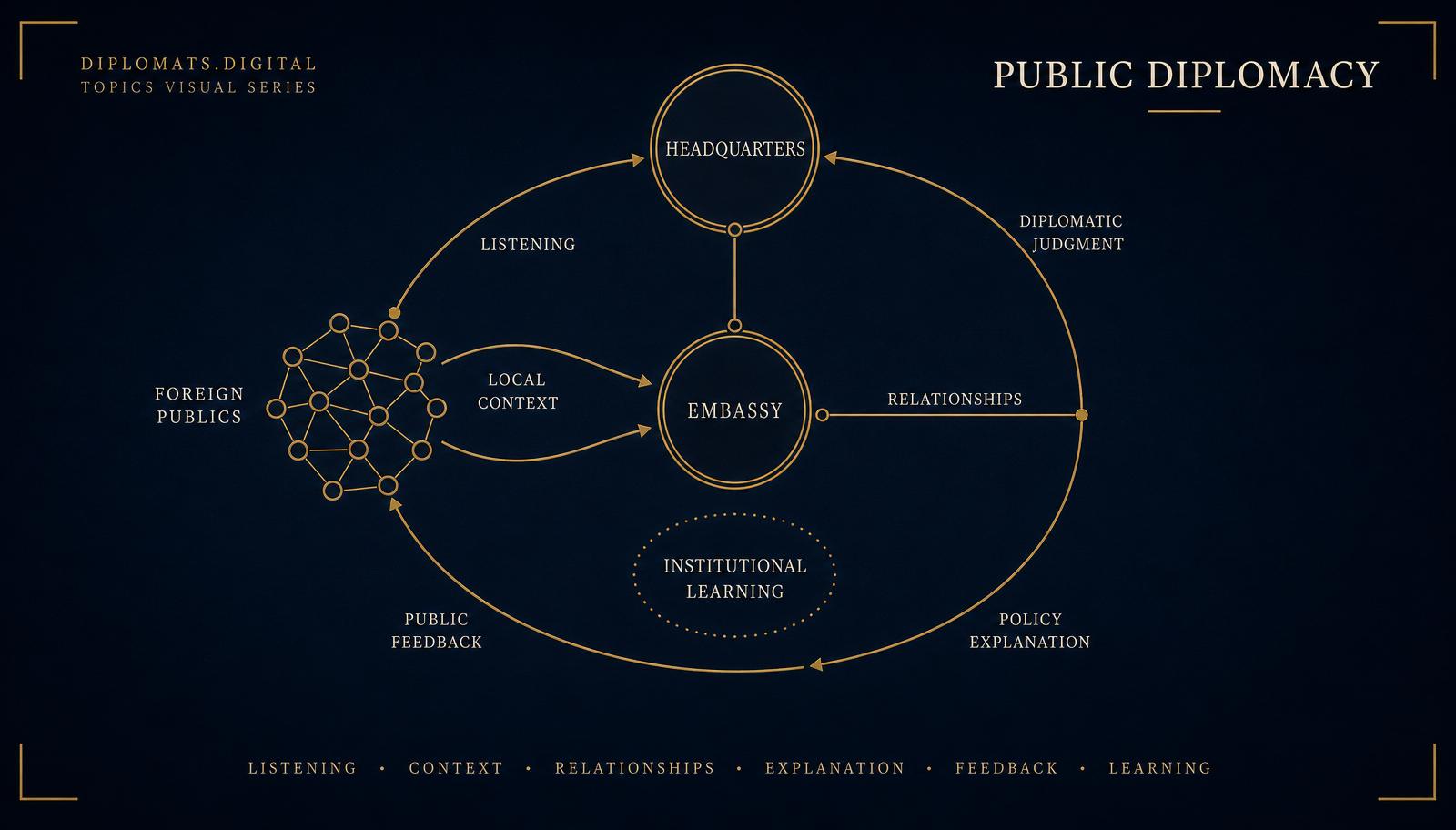
Why public diplomacy should be treated as institutional relationship capacity
How to use this article — a Diplomats.Digital guide to understanding public diplomacy as an institutional capacity built through listening, local knowledge, credible relationships, policy explanation, public feedback and institutional learning. Read the article for the full operating logic and use the assessment questions to examine existing ministry and mission capability.
- Foreign publics increasingly influence the environment in which foreign policy is understood, contested and implemented.
- Embassies often hold essential local knowledge, but institutions need reliable ways to bring that knowledge into headquarters and policy judgment.
- Credible relationships and public trust cannot be created only when a crisis has already begun.
- Public diplomacy should generate institutional learning, not only events, campaigns, posts or audience metrics.
MoFA leadership, public diplomacy departments, embassy leadership, press and cultural teams, geographic desks, policy-planning units, narrative-resilience teams, locally engaged staff, institutional reform teams and diplomats responsible for public engagement.
Can the ministry consistently turn engagement with foreign publics into local understanding, credible relationships, better policy explanation and institutional learning?
What reading this helps you do
- Distinguish public diplomacy capability from visibility, campaigns and social-media activity.
- Understand how listening, local context and relationships contribute to diplomatic judgment.
- Assess whether public insight can travel from foreign publics and missions into headquarters, policy and institutional learning.
Key Insights
Visibility is part of public diplomacy. Institutional relationship capacity is the deeper objective.
- 02
Listening becomes institutional capability when observations can be interpreted, verified, recorded, shared and used.
- 03
Embassies provide local context and headquarters provides policy authority; an effective feedback loop must connect the two.
- 04
Public-diplomacy relationships require institutional continuity beyond individual ambassadors, officers, campaigns and rotation cycles.
- 05
Public diplomacy strengthens narrative resilience when credible relationships and local understanding exist before pressure begins.
Public diplomacy is the institutional capacity to listen, understand local contexts, build credible relationships, explain policy and bring what institutions learn from foreign publics back into diplomatic judgment.
Public diplomacy takes place wherever foreign policy meets public experience
Public diplomacy takes place wherever foreign policy meets public experience.
It includes the conversations, relationships, explanations, signals and forms of engagement through which diplomatic institutions interact with people outside formal government channels. These interactions may involve journalists, researchers, educators, civil society organisations, cultural actors, professional communities, businesses, diaspora groups, young people and wider foreign publics.
Visibility is part of this work. It is not the whole of it.
A ministry or embassy can publish frequently, organise events and reach large audiences without necessarily developing a deeper understanding of the society in which it operates. Institutional public diplomacy begins when engagement produces knowledge, relationships and better diplomatic judgment.
A working definition
Public diplomacy is the institutional capacity to listen, understand local contexts, build credible relationships, explain policy and bring what institutions learn from foreign publics back into diplomatic decision-making.
This definition places public diplomacy within the operating capacity of a foreign ministry.
It connects external engagement with:
- embassy capability;
- institutional listening;
- local knowledge;
- public trust;
- narrative resilience;
- policy explanation;
- public feedback;
- institutional learning.
The value of public diplomacy therefore depends on more than the quality of individual campaigns. It depends on whether the institution can convert engagement into lasting knowledge and coordinated action.
Institutional listening
Diplomatic institutions need ways to understand how policies, events and international developments are being interpreted locally.
This requires more than monitoring media coverage or collecting social media metrics. Useful listening includes direct engagement, observation, trusted relationships and careful interpretation of the social and political environment.
A mission may need to understand:
- which issues matter locally;
- how different communities interpret the same event;
- which concerns are emerging before they become visible at national level;
- where trust is weakening;
- which narratives are gaining credibility;
- how a policy announcement may be received outside the institution.
Listening becomes institutional capacity when these observations can be verified, recorded, shared and included in diplomatic assessment.
Local context
Messages do not enter empty environments.
They enter societies with their own histories, political tensions, cultural references, information habits and levels of trust in institutions. Language that works in one country may appear distant, defensive or unclear in another.
Embassies are especially important because they operate close to these contexts. Their local networks and daily exposure can reveal details that are difficult to see from headquarters.
Public diplomacy therefore requires a functioning relationship between local understanding and central policy. Missions need room to interpret the environment, while headquarters needs reliable ways to receive, compare and use those insights.
Credible relationships
The most valuable public diplomacy relationships are rarely created during a crisis.
They develop through consistency, professional respect, careful listening and continued presence. These relationships help diplomatic institutions understand changes in the local environment and communicate more credibly when difficult issues emerge.
Relationship capacity should not depend entirely on one ambassador, press officer or locally employed colleague. Personal trust matters, but the institution also needs continuity.
This means preserving:
- relevant contact networks;
- engagement history;
- local knowledge;
- previous commitments;
- institutional memory;
- lessons from earlier interactions.
Without continuity, public diplomacy repeatedly starts again when people rotate or responsibilities change.
Explaining policy
Foreign policy is often difficult to communicate because it involves negotiation, uncertainty, legal constraints, competing interests and decisions that may still be developing.
Public diplomacy helps institutions explain policy in ways that are accurate, accessible and relevant to local audiences.
Effective explanation does not mean simplifying every issue into a slogan. It means helping people understand:
- what the institution is doing;
- why a decision was made;
- what remains uncertain;
- who is affected;
- what the institution can and cannot do;
- how the issue connects to the local environment.
Credibility depends on the relationship between words, evidence and institutional behaviour. Communication cannot compensate for inconsistency between policy and action.
Bringing public insight back into diplomacy
Public diplomacy should create an institutional feedback loop.
Information gathered through engagement must be able to travel back into the organisation. Local questions, concerns and interpretations can help ministries identify risks, test assumptions and understand how foreign policy is experienced outside official settings.
This is where public diplomacy becomes part of diplomatic judgment.
A useful feedback loop may include:
- Listening to foreign publics and local partners.
- Interpreting observations within their local context.
- Verifying important signals.
- Sharing them across the mission and with headquarters.
- Assessing their relevance for policy and communication.
- Adjusting engagement where necessary.
- Preserving lessons for future teams.
Without this loop, engagement generates activity but limited institutional learning.
Public diplomacy and narrative resilience
Narrative resilience depends partly on the strength of relationships that exist before a contested narrative or information crisis appears.
Institutions with credible local relationships are better positioned to understand how a narrative is spreading, why it is persuasive and which communities may be affected. They are also more likely to receive early signals from trusted partners.
This does not mean using relationships only as communication channels. Their value comes from mutual understanding and credibility developed over time.
Public diplomacy contributes to narrative resilience by improving:
- early awareness;
- contextual interpretation;
- access to trusted local perspectives;
- policy explanation;
- institutional credibility;
- the ability to respond without losing public trust.
Questions for institutional assessment
A foreign ministry examining its public diplomacy capacity should ask:
- Can missions identify meaningful changes in local public attitudes?
- Does local knowledge reach the teams responsible for policy?
- Are public insights distinguished from unverified impressions?
- Can relationships continue when diplomatic personnel rotate?
- Are locally employed colleagues included in institutional learning?
- Is public feedback recorded and used?
- Can headquarters adapt its guidance when local context requires it?
- Does the institution measure trust and understanding, or mainly visibility?
- Are lessons from past engagement available to future teams?
- Can the institution communicate clearly during uncertainty?
These questions move the assessment beyond the number of posts, events or followers.
From activity to capacity
Public diplomacy becomes an institutional capability when an organisation can listen consistently, understand context, maintain relationships, explain policy and learn from engagement across time.
The objective is not permanent visibility.
The objective is a stronger relationship between diplomatic institutions and the publics whose trust, interpretation and participation increasingly shape the environment in which foreign policy operates.
For the broader institutional context, see What Is Digital Diplomacy?, Embassy Digital Transformation, The Conversion Deficit, and The Future Ministry of Foreign Affairs.
Selected institutional references
Institutional references and primary sources used to ground the article.
- United NationsVienna Convention on Diplomatic Relations, 1961 — Article 3
Codifies the enduring diplomatic functions on which public diplomacy builds.
- European External Action ServicePublic diplomacy and international cultural relations
EU institutional framing of public diplomacy and cultural engagement.
- NATOCommittee on Public Diplomacy
Alliance-level institutional structure for public diplomacy coordination.
- OECDTrust in Government
Evidence base on public trust in institutions relevant to public diplomacy.
- UNESCOIntercultural Dialogue
Anchor for cross-cultural understanding and institutional listening.
What Is Digital Diplomacy?
A foundational definition of digital diplomacy and its institutional implications.
Read guideNarrative Resilience in Foreign Affairs
Why diplomatic institutions need institutional judgment, not only message control.
Read guideEmbassy Digital Transformation
How missions become digitally enabled field nodes for coordination and public engagement.
Read guideThe Conversion Deficit
Why digital diplomacy activity often fails to convert into institutional advantage.
Read guideTanzania Digital Diplomacy Capability Profile
A whole-of-government model combining established e-government foundations, expanding foreign-affairs digital systems, emerging AI governance and an overseas mission network, with documented efforts to strengthen cross-government follow-through on mission-generated opportunities.
Read guide