
- Institutional Capability
- Digital Diplomacy
- AI & Foreign Affairs
- Coordination
The Conversion Deficit
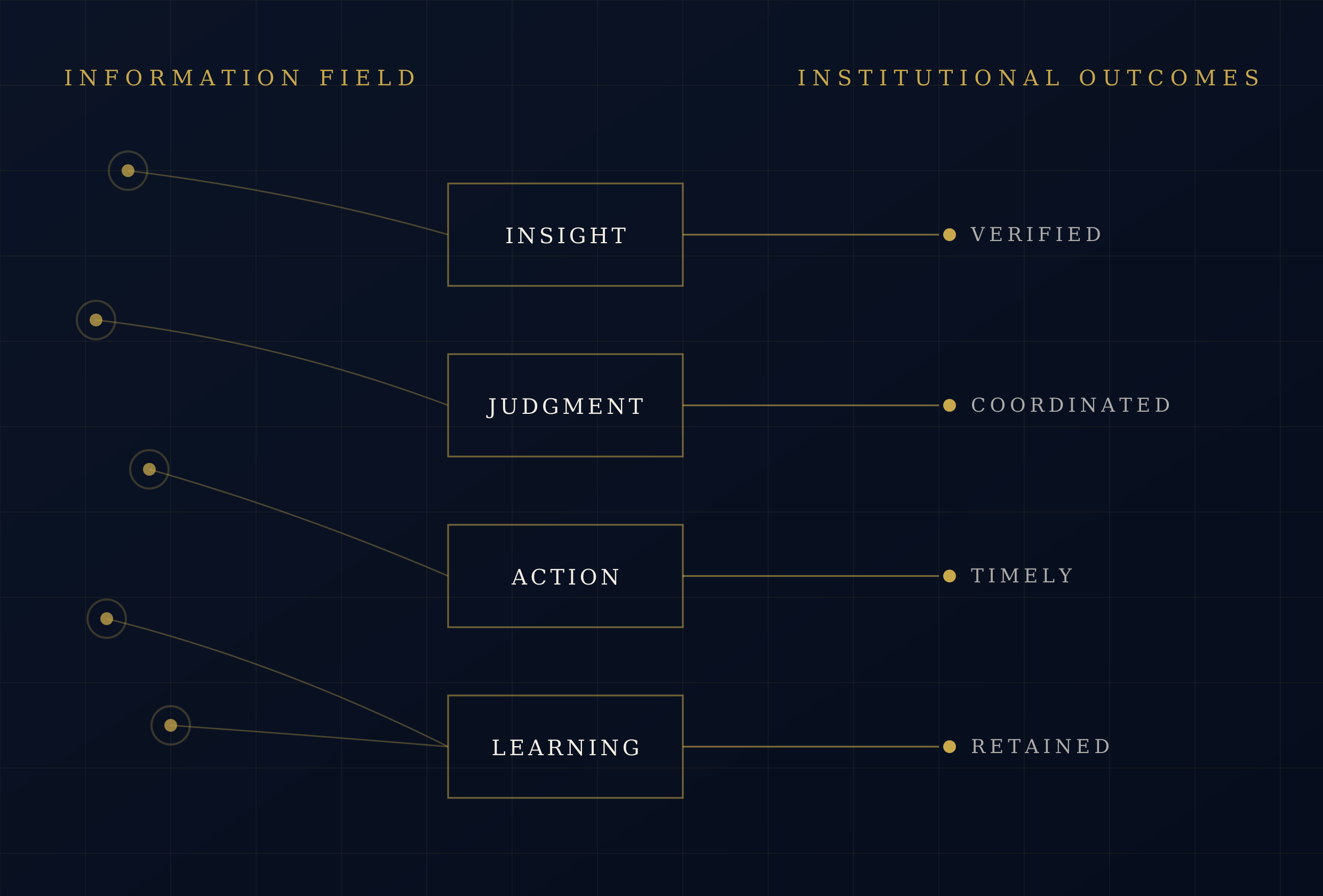
Foreign ministries operate in information-rich, increasingly distributed environments. Their central challenge is institutional conversion: consistently transforming that information into verified insight, coordinated judgment, timely action, and institutional learning.
This creates a recurring institutional gap between information availability and coordinated action.
The institutional conversion deficit is the gap between the information available to a foreign ministry and its ability to consistently transform that information into verified insight, coordinated judgment, timely action, and retained institutional learning.
Diplomats.Digital working definition, 2026
What the concept explains
The conversion deficit describes a recurring institutional problem: information may be collected successfully without being converted consistently into shared understanding, coordinated decisions, timely action, and retained learning.
It shifts attention from information volume and technology adoption toward the institutional chain connecting information, verification, judgment, coordination, action and learning.
Source: Laura Iancu, "The Conversion Deficit," Diplomats.Digital, 2026.
© 2026 Diplomats.Digital. This figure may be reproduced for non-commercial research, education and policy use with attribution and a link to the original source.
Seven signs your institution may have a conversion deficit
Missions monitor different information environments using inconsistent methods.
Headquarters receives overlapping or contradictory reporting.
Policy, communications, security, and geographic teams interpret the same development differently.
AI-generated summaries blur verified facts, inference, and interpretation.
Escalation thresholds are informal or dependent on personalities.
Teams identify risks but do not know who owns the next decision.
Lessons disappear when staff rotate, crises pass, or vendors change.
How many of these seven signs exist within your institution?
If several of these signs are present, the institution may be facing more than an information or technology problem. It may be experiencing the institutional Conversion Deficit.
Why this matters
Digital transformation has given foreign ministries more tools, more monitoring capacity, more data, and now more AI-generated outputs. But information abundance does not automatically create stronger institutional judgment.
Most technologies strengthen the beginning of the process: collection, detection, and summarisation. The harder institutional failures occur later — during verification, interpretation, prioritisation, escalation, coordination, decision, and learning.
A conversion deficit is therefore not primarily a technology gap. It is an operating-capability gap.
Concept boundaries
- An institutional operating-capability problem.
- A gap between information availability and coordinated institutional outcomes.
- A diagnostic lens for workflows, authority, escalation and learning.
- Relevant to both human and AI-assisted processes.
- A simple lack of information.
- A synonym for digital immaturity.
- Only a technology or data problem.
- Proof that greater centralisation is always the answer.
- A single numerical score without a defined assessment methodology.
Potential applications
The concept can support foreign ministry capability reviews, mission–headquarters workflow analysis, AI governance and human-oversight design, crisis coordination exercises, reporting and escalation reviews, institutional-learning assessments, diplomatic training, simulation and research into digital transformation.
Research questions
Which institutional bottlenecks most frequently prevent foreign ministries from converting distributed information into coordinated action?
How does AI-assisted summarisation change the location and nature of the conversion deficit?
Which governance, workflow and learning mechanisms reduce conversion loss between missions and headquarters?
Concept development
Diplomats.Digital introduced this concept note in July 2026 as part of its work on institutional capability in foreign affairs. The concept will inform the forthcoming Diplomatic Conversion Readiness Assessment and related research on how foreign ministries transform distributed information into coordinated institutional outcomes.
Current version: 1.0 — 14 July 2026
How to cite
- Recommended citation
- Iancu, Laura. "The Conversion Deficit." DD Insight 01 · Concept Note, Diplomats.Digital, 14 July 2026, version 1.0. https://diplomats.digital/insights/dd-insight-01-the-conversion-deficit
- APA
- Iancu, L. (2026, July 14). The conversion deficit (DD Insight 01 · Concept Note, version 1.0). Diplomats.Digital. https://diplomats.digital/insights/dd-insight-01-the-conversion-deficit
- Chicago
- Laura Iancu, "The Conversion Deficit," DD Insight 01 · Concept Note, version 1.0 (Diplomats.Digital, July 14, 2026), https://diplomats.digital/insights/dd-insight-01-the-conversion-deficit.
- BibTeX
@misc{iancu2026conversiondeficit,
  author       = {Laura Iancu},
  title        = {The Conversion Deficit},
  year         = {2026},
  month        = {July},
  publisher    = {Diplomats.Digital},
  howpublished = {DD Insight 01 · Concept Note},
  url          = {https://diplomats.digital/insights/dd-insight-01-the-conversion-deficit},
  note         = {Version 1.0}
}
Capability begins where information becomes coordinated action.
Diplomats.Digital is developing a Diplomatic Conversion Readiness Assessment to help foreign ministries identify structural bottlenecks between information, judgment, coordination, action, and institutional learning.
Related
Digital Diplomacy Capability Framework
A diagnostic model for identifying the institutional conditions behind information conversion, coordination and learning.
Digital Diplomacy Operating Framework
The six-stage institutional cycle for turning distributed signals into coordinated diplomatic action.
Digital Diplomacy & Institutional Readiness
Why institutional readiness — not additional visibility — is the next frontier of foreign-affairs capability.