
The Future Ministry of Foreign Affairs: From Digital Communication to Institutional Capability
Foreign ministries do not need to be reinvented. But the operating environment around them is changing. The next phase of foreign affairs modernization is the development of institutional capability.
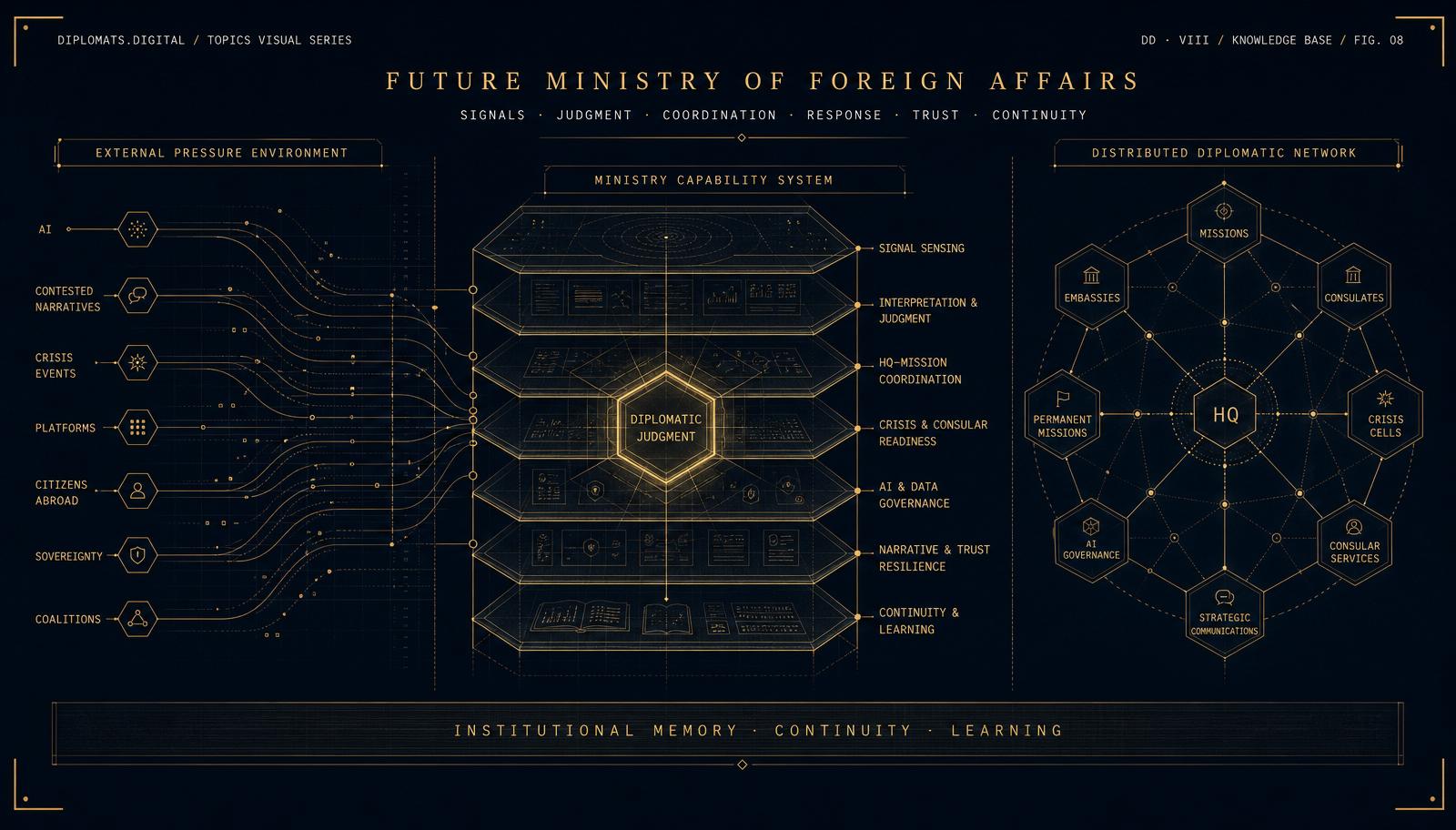
A strategic orientation for foreign affairs leaders, missions, digital teams, and institutional reform units
How to use this guide — a strategic orientation for understanding why the future Ministry of Foreign Affairs is not only a more digital institution, but a more coordinated, adaptive, and resilient one. Read the brief for orientation; consult the framework, implications, and readiness check for diagnosis.
- Foreign ministries are already operating in a faster, more public, more contested, and more technically mediated environment.
- Digital diplomacy can no longer be reduced to communication, visibility, or social media presence.
- AI, information manipulation, crisis pressure, digital sovereignty, and platform dependency are becoming institutional issues, not only technical or communications issues.
- Embassies and consulates are becoming digitally enabled field nodes: sensing, serving, interpreting, coordinating, and responding.
- The next stage of modernization is not tool adoption. It is institutional readiness.
MoFA leadership, secretaries-general, directors of digital transformation, policy planning units, crisis and consular directors, strategic communications teams, public diplomacy departments, embassy leadership, CIOs, AI governance leads, training academies, and institutional reform teams.
Can the ministry coordinate judgment, technology, people, missions, data, crisis response, and public trust fast enough — without losing diplomatic discipline, institutional memory, sovereignty, or credibility?
What reading this helps you do
- Reframe digital diplomacy as institutional capability, not only digital communication.
- Understand five pressures shaping the future MoFA: AI, narrative pressure, crisis velocity, digital sovereignty, and distributed diplomatic action.
- Assess whether existing digital tools are becoming institutional capability or remaining fragmented projects.
Key Insights
The future MoFA is not a replacement of traditional diplomacy. It is the institutional strengthening of diplomacy under new operating conditions.
- 02
Digital communication was the first phase. Institutional capability is the next phase.
- 03
AI does not only create new tools for diplomats. It changes the speed, uncertainty, verification burden, and governance responsibilities around diplomatic work.
- 04
Narrative resilience is becoming operational. It requires early warning, interpretation, coordination, response discipline, and institutional learning.
- 05
Embassies are no longer only representational posts. They are increasingly field nodes in a distributed system of sensing, service delivery, crisis response, local engagement, and trusted interpretation.
The MoFA Institutional Capability System
Seven institutional layers foreign ministries can use to assess how prepared they are for a more digital, AI-shaped, contested, and crisis-prone operating environment.
A ministry is not future-ready because it has more digital tools. It is future-ready when it can coordinate judgment under pressure.
- 01Layer I
Signal sensing
Detecting early signals from diplomatic networks, media, platforms, missions, open sources, partner institutions, local communities, and internal reporting.
Diagnostic questionCan the ministry detect relevant signals early enough to understand what is changing before the issue becomes a crisis?
- 02Layer II
Interpretation and judgment
Turning signals into meaning. This includes geopolitical interpretation, local context, audience understanding, diplomatic nuance, legal sensitivity, and institutional memory.
Diagnostic questionCan the ministry distinguish noise from meaningful change without reacting too late or too quickly?
- 03Layer III
HQ–mission coordination
Connecting headquarters, embassies, consulates, permanent missions, regional desks, thematic units, and leadership into coherent workflows.
Diagnostic questionCan headquarters and missions coordinate quickly without flattening local judgment or creating approval bottlenecks?
- 04Layer IV
Crisis and consular readiness
Preparing for rapid escalation across citizen protection, evacuation, communication, documentation, local coordination, partner activation, and public reassurance.
Diagnostic questionCan the ministry support citizens, missions, and leadership during fast-moving disruptions without relying only on improvised coordination?
- 05Layer V
AI and data governance
Using AI, data, automation, and analytics responsibly while protecting confidentiality, sovereignty, privacy, human judgment, and accountability.
Diagnostic questionIs AI governed as institutional infrastructure, or is it spreading informally through individual experimentation and disconnected tools?
- 06Layer VI
Narrative and trust resilience
Understanding contested narratives, information manipulation, perception shifts, foreign publics, and credibility risk without reducing diplomacy to message control.
Diagnostic questionCan the ministry respond to narrative pressure without amplifying manipulation, fragmenting its own voice, or losing strategic discipline?
- 07Layer VII
Continuity and learning
Preserving institutional knowledge, lessons from crises, operational memory, digital playbooks, training routines, and adaptive capacity across political cycles and staff rotation.
Diagnostic questionDoes the ministry learn structurally from pressure, or does knowledge remain trapped in individuals, missions, inboxes, and past crises?
Foreign ministries do not need to be reinvented. But the operating environment around them is changing. The next phase of foreign affairs modernization is not simply more digital communication. It is the development of institutional capability: the ability to sense, interpret, coordinate, decide, communicate, and learn across headquarters, missions, partners, and publics.
From digital communication to institutional capability
Foreign ministries do not need to be told that diplomacy is changing.
They experience it through crisis rooms, embassy reporting, emergency consular calls, social media storms, AI-generated content, ministerial travel, cyber incidents, platform dependencies, public expectations, and coalition politics.
The more useful question is not whether foreign ministries are “modern” or “behind.” That language is too simple for institutions whose work depends on caution, sovereignty, trust, discretion, and national responsibility.
The more useful question is this:
Has the operating environment around foreign ministries changed faster than the institutional systems designed to support diplomatic judgment?
For many ministries, the answer is not a failure. It is a structural reality.
Foreign ministries were designed for continuity, representation, negotiation, discretion, analysis, protection of citizens, and the advancement of national interest. Those functions remain essential. But the environment around them has become faster, more public, more technically mediated, and more contested.
That is why the next phase of digital diplomacy is not simply better communication.
It is institutional capability.
Why communication is no longer enough
The first era of digital diplomacy was largely about presence.
Foreign ministries built websites, opened social media accounts, trained spokespersons, created public diplomacy campaigns, launched digital engagement units, and experimented with new formats.
That work was necessary.
But the pressure has moved.
A ministry may communicate well and still struggle to coordinate internally.
An embassy may be visible online and still lack crisis-ready workflows.
A digital team may produce excellent content but remain disconnected from policy planning, consular services, cyber teams, AI governance, or regional desks.
A ministry may adopt AI tools but lack a shared doctrine for when, how, and where those tools should be used.
A mission network may detect local signals but have no structured way to translate them into institutional learning.
This is the difference between digital activity and institutional capability.
Digital activity asks: Are we using digital tools?
Institutional capability asks: Can the ministry act with coherence, judgment, speed, and trust when the environment becomes unstable?
Five pressures shaping the future MoFA
01 · AI as an operating layer
AI in foreign affairs is no longer only a technology topic. It is becoming part of how information is produced, summarized, interpreted, manipulated, translated, searched, and acted upon.
For foreign ministries, this creates opportunities: faster research, multilingual support, knowledge retrieval, consular triage, scenario analysis, internal drafting, and structured monitoring.
It also creates risks: overreliance, hallucination, data exposure, bias, synthetic media, impersonation, automation without accountability, and the gradual outsourcing of judgment.
The OECD frames trustworthy AI in government through enablers, guardrails, and engagement. It identifies governance, data, digital infrastructure, skills, investment, procurement, and partnerships as core enablers, while emphasizing proportionate guardrails, transparency, oversight, and risk management.
For MoFAs, the central issue is not whether AI will be used.
It already will be.
The question is whether AI becomes governed institutional capability or informal individual practice.
02 · Narrative pressure
Foreign ministries have always dealt with narratives. What has changed is speed, scale, fragmentation, and technical amplification.
Information manipulation can now move across platforms, languages, communities, influencers, state-backed channels, encrypted groups, and synthetic media formats before official systems have completed verification.
The EEAS has described 2025 as a turning point in its approach to Foreign Information Manipulation and Interference, shifting toward a more operational and response-oriented model through a FIMI Situational Awareness Hub, early warning, coordinated responses, training, and partner cooperation.
This matters because narrative resilience is not only a communications task.
It requires sensing, interpretation, coordination, decision discipline, and institutional trust.
The challenge is no longer only whether a ministry can correct false information. It is whether the institution can detect narrative movement early, understand the audience and intent, coordinate with partners, and respond without amplifying the manipulation it is trying to contain.
03 · Crisis velocity
Crises compress time.
During the COVID-19 pandemic, consular services became a mass coordination system. Citizens were stranded abroad, borders closed, commercial routes collapsed, and governments had to coordinate with airlines, missions, EU mechanisms, local authorities, families, and public communication channels. The European Parliamentary Research Service estimated that more than 200,000 EU citizens were stranded outside the EU during the crisis.
This is not a story of failure. It is a stress test.
It showed that consular work is no longer a slow administrative function at the edge of foreign policy. In moments of global disruption, it becomes a real-time institutional capability involving headquarters, missions, transport providers, regional mechanisms, citizens, and public communication.
The future MoFA needs crisis systems that are not invented only during crisis.
04 · Digital sovereignty
Foreign ministries operate in a digital environment largely built by actors outside the ministry: platforms, cloud providers, AI vendors, telecommunications networks, cybersecurity firms, identity providers, and data infrastructure operators.
This does not mean ministries must build everything themselves.
It does mean they need decision-making that preserves institutional control and retained authority.
Digital sovereignty for foreign affairs is not isolation. It is the ability to choose, govern, audit, adapt, and retain institutional control over critical capabilities.
France’s Ministry for Europe and Foreign Affairs explicitly links digital transformation to sovereign missions, secure trade and data, influence, crisis management applications, and improved services for French citizens abroad.
For MoFAs, the strategic question is not “which technology should we buy?”
It is: which institutional capabilities must remain governable by the ministry?
05 · Distributed diplomatic action
Foreign policy is no longer executed only from headquarters.
Embassies, consulates, permanent missions, special envoys, digital ambassadors, development agencies, trade offices, cultural institutes, crisis teams, locally engaged staff, partner ministries, and external experts all form part of the operating environment.
Global Affairs Canada’s Future of Diplomacy work is useful here because it makes the institutional complexity visible. It notes approximately 8,300 Canada-based staff and 5,600 locally engaged staff, with locally engaged staff representing 81% of GAC staff at missions. It also notes that only 26% of Canada-based employees occupy foreign service positions.
The lesson is larger than Canada.
The future MoFA is not only a diplomatic corps. It is a complex institutional network.
That network needs coordination, knowledge sharing, digital tools, mission autonomy, leadership clarity, and institutional memory.
The future ministry is not a platform
It is tempting to imagine the future MoFA as a technology platform.
That would be the wrong frame.
A foreign ministry is not a software product. It is a sovereign institution with legal, diplomatic, political, historical, human, and operational responsibilities.
The future ministry may use platforms. It may use AI. It may use dashboards, secure channels, automated tools, digital identity, data systems, and crisis applications.
But the institution itself cannot be reduced to those tools.
The future MoFA is better understood as a capability system:
- a sensing system,
- an interpretation system,
- a coordination system,
- a crisis system,
- a trust system,
- a learning system,
- and a sovereign judgment system.
The value lies not in the number of tools, but in the way people, processes, technologies, missions, and decisions work together. This is where Foreign Affairs Innovation becomes structural, not decorative.
The adoption problem
One of the most important lessons from digital transformation is that tools are not adopted simply because they exist.
Public institutions face a harder adoption problem than private companies. They must consider public trust, legal accountability, political sensitivity, confidentiality, procurement rules, cybersecurity, continuity, inclusion, and institutional legitimacy.
The OECD notes that government AI adoption is slowed by skill gaps, legacy IT systems, limited data, tight budgets, and stricter needs for privacy, transparency, and representation.
For MoFAs, this problem is even sharper.
A tool that works in headquarters may not work at a small mission.
A dashboard that looks useful to leadership may add burden to staff.
An AI assistant may be efficient but inappropriate for sensitive diplomatic material.
A social listening tool may generate signals but not institutional interpretation.
A new approval process may increase safety while slowing response beyond usefulness.
That is why the design question should not be:
What technology can we deploy?
It should be:
What institutional workflow are we making safer, faster, clearer, or more trusted?
Synthetic media as a verification stress test
AI-generated content does not need to decide an election or trigger a crisis on its own to matter.
Its strategic effect may be narrower but still serious: it compresses verification time, increases hesitation, burdens communicators, creates uncertainty, and makes trust more operationally expensive.
The Slovakia 2023 deepfake audio case is useful precisely because serious researchers caution against overclaiming its effect. Harvard Kennedy School’s Misinformation Review argues that the case should not be reduced to “the election swung by deepfakes,” and that deeper factors such as low trust, long-term influence operations, encrypted messaging, and political amplification matter.
For foreign ministries, the lesson is not panic.
The lesson is readiness.
Can the institution verify quickly?
Can it coordinate the response?
Can it avoid amplifying the falsehood?
Can it brief leadership with uncertainty clearly stated?
Can it protect credibility while facts are still being established?
Synthetic media is not only a communications challenge.
It is a verification, coordination, and trust challenge. Purpose-built environments such as DiplomatIQ exist to rehearse exactly this kind of pressure.
From public diplomacy to institutional trust
Public diplomacy remains important.
Strategic communications remain important.
Digital diplomacy remains important.
But they now sit inside a wider institutional trust problem.
Foreign ministries must communicate in environments where publics may distrust institutions, platforms may amplify emotion over accuracy, AI may generate persuasive falsehoods, and geopolitical actors may seek to weaken confidence before facts are established.
The UN Global Digital Compact recognizes that digital and emerging technologies can facilitate manipulation and interference with information, and it calls for responsible, accountable, transparent, human-centric approaches to technology governance with human oversight.
For MoFAs, this means trust cannot be treated only as reputation.
Trust becomes operational.
It depends on the ministry’s ability to verify information, coordinate internally, explain uncertainty, protect citizens, use technology responsibly, and preserve continuity.
The mission network becomes central
The embassy of the future is not only an outpost.
It is a field node. See Embassy Digital Transformation for the full framing of embassies as field nodes.
It senses local signals.
It interprets context.
It supports citizens.
It builds trust.
It detects weak signals.
It coordinates with headquarters.
It works with local partners.
It explains national positions.
It protects institutional reputation.
It contributes to crisis response and long-term learning.
This does not make missions less diplomatic.
It makes their diplomatic judgment more important.
In a fragmented information environment, local understanding becomes a strategic asset. The challenge is to connect that asset to the wider ministry without over-centralizing it. This is also where Diplomatic Technology choices — secure channels, structured reporting, shared playbooks — decide whether missions can inform HQ at speed.
A future-ready MoFA does not simply push messages from headquarters to missions.
It creates structured ways for missions to inform headquarters, coordinate with each other, and adapt central guidance to local realities.
The continuity problem
Foreign ministries are built around rotation, political cycles, crisis surges, institutional memory, and changing priorities.
This creates a continuity challenge.
Lessons from one crisis may not become doctrine.
A strong digital team may depend on a few individuals.
Mission knowledge may remain in local files or personal relationships.
AI experimentation may spread without shared governance.
Narrative response may improve during a crisis but weaken afterward.
Training may exist but not be connected to real operational workflows.
Continuity is therefore a core capability.
The future MoFA needs ways to preserve institutional learning across people, tools, crises, and leadership transitions.
The question is not only: what did we learn?
It is: where did that learning go?
Five institutional signals, five lessons
- 01Canada implication
Transformation as institutional strengthening
Global Affairs Canada's Future of Diplomacy work is important because it does not frame modernization as a communications upgrade. It addresses people, tools, processes, culture, mission networks, knowledge management, recruitment, crisis support, and the role of locally engaged staff. Lesson for foreign affairs: the future MoFA is a whole-institution question, not a digital department question.
- 02France implication
Digital transformation as sovereign mission support
France's Ministry for Europe and Foreign Affairs frames digital transformation around sovereign missions, secure data, influence, crisis management applications, online services, and better staff experience. Lesson for foreign affairs: digital transformation is strongest when it supports core diplomatic and consular missions, not when it sits beside them.
- 03United Kingdom implication
Capability networks, not isolated expertise
The FCDO's Digital Development Strategy states that the department will strengthen its own digital development capability through staff training, technical competency frameworks, knowledge exchange, stronger core structures, and a professionalized network of digital development advisers across headquarters and overseas teams. Lesson for foreign affairs: capability needs networks, training, structures, and professional pathways — not only project teams.
- 04European Union / EEAS implication
Narrative resilience as operational response
The EEAS FIMI work shows a shift from analysis alone toward situational awareness, early warning, coordinated responses, training, resilience-building, and partner cooperation. Lesson for foreign affairs: information manipulation is not only a content problem. It is an operational environment.
- 05OECD / UN implication
AI governance as public-sector capability
OECD and UN work both point toward a more mature approach to AI: enablers, guardrails, human oversight, transparency, accountability, interoperability, capacity-building, and risk-based governance. Lesson for foreign affairs: AI adoption inside MoFAs should be governed as institutional capability, not treated as informal productivity experimentation.
Leadership Questions
A reflection set for senior diplomatic leadership assessing the next phase of foreign affairs modernization.
- 01
Are we treating digital diplomacy as communication activity or as institutional capability?
- 02
Where do early signals enter the ministry — and how are they interpreted, escalated, or ignored?
- 03
Can headquarters and missions coordinate quickly during narrative pressure without losing local judgment?
- 04
Which workflows still depend on inboxes, PDFs, screenshots, informal calls, or individual memory?
- 05
Do we have a clear doctrine for AI use inside the ministry?
- 06
Which AI uses are permitted, restricted, sensitive, or prohibited?
- 07
Can we verify synthetic media, impersonation attempts, or manipulated documents quickly enough?
- 08
Are consular crisis workflows designed for mass coordination, or mainly for normal-time service delivery?
- 09
What institutional knowledge disappears when staff rotate, crises end, or teams change?
- 10
Which capabilities must remain sovereign, auditable, and institutionally controlled?
- 11
Do missions have enough autonomy to adapt centrally approved guidance to local realities?
- 12
Who owns institutional learning after a crisis?
Future MoFA Capability Readiness Check
A lightweight self-assessment for senior leadership. Rate each dimension on a 1–5 scale to identify where the ministry is mature, uneven, or structurally exposed.
- 01Early signal sensing
- 02Interpretation and judgment workflows
- 03HQ–mission coordination
- 04Crisis and consular readiness
- 05AI governance and responsible use
- 06Narrative resilience and information integrity
- 07Digital sovereignty and vendor governance
- 08Secure internal knowledge sharing
- 09Training and adoption
- 10Institutional learning and continuity
Selected Institutional References
A curated set of institutional sources that inform this guide. Each entry includes why it matters for ministries assessing the future MoFA as a capability system.
- Global Affairs CanadaFuture of Diplomacy: Transforming Global Affairs Canada — Discussion Paper (2023)
The strongest MoFA-specific institutional reform reference; includes the point that only 26% of Canada-based GAC employees occupy foreign service positions.
- Global Affairs CanadaTransformation Implementation Plan 2023–2026
Frames transformation as delivery across foreign affairs, trade, international assistance, and consular support.
- France DiplomatieMinistry Digital Transformation Plan
Explicitly links digital transformation to sovereign missions, secure data, influence, and crisis management applications.
- UK FCDODigital Development Strategy 2024–2030
Sets out the idea that digital capability requires people, skills, structures, advisers, and networks — not only tools.
- OECDGoverning with Artificial Intelligence (2024)
Public-sector AI governance: enablers, guardrails, transparency, oversight, risk management, public trust, skills, infrastructure, procurement.
- OECDGoverning with Artificial Intelligence — PDF
Full PDF of the OECD trustworthy AI adoption framework for government.
- United NationsGlobal Digital Compact
UN-level anchor for responsible, interoperable data governance and AI-related risk governance.
- EEAS2025 Report on Activities to Counter Foreign Information Manipulation and Interference (FIMI)
Shows the shift of information manipulation from a communications issue to an operational-response issue.
- European Parliamentary Research ServiceRepatriation of EU Citizens during the COVID-19 Crisis (Briefing)
Source for the figure that more than 200,000 EU citizens were stranded outside the EU during COVID-19.
- European Parliamentary Research ServiceRepatriation of EU Citizens during COVID-19 — PDF
Full PDF version of the EPRS briefing on consular repatriation coordination.
- ITUMeasuring Digital Development: Facts and Figures 2025
Source for the figure that around 6 billion people (approximately 74% of the world's population) are online in 2025, while 2.2 billion remain offline.
- ITUFacts and Figures 2025 — Publication Page
Alternative publication page for the ITU 2025 measurement dataset.
- World Economic ForumGlobal Risks Report 2024 — Press Release
Anchors the claim that misinformation and disinformation ranked among the biggest short-term global risks.
- World Economic ForumGlobal Risks Report 2024
Report page for the 2024 risk framing and multipolar / fragmented order expectation.
- World Economic ForumGlobal Risks Report 2024 — PDF
Full PDF for institutional readers and reference libraries.
- World Economic ForumGlobal Risks Report 2025
Used where the article refers to 2025 risk continuity and the increasingly fractured global landscape.
- Harvard Kennedy School Misinformation ReviewBeyond the Deepfake Hype: AI, Democracy, and 'the Slovak Case'
Careful, non-alarmist framing of synthetic media: the point is verification, trust, and coordination pressure — not that deepfakes decided an election.
For ministries assessing where to begin, Diplomats.Digital offers a confidential institutional briefing on the future Ministry of Foreign Affairs as a capability system: AI governance, narrative resilience, mission coordination, crisis readiness, digital sovereignty, and institutional continuity.
Developed by Diplomats.Digital as part of its institutional capability research for ministries of foreign affairs.
AI, Public Diplomacy and the Hanover Institute
How generative engine optimisation, source provenance and AI-mediated information environments reshape narrative resilience.
Read guideWhat Is Digital Diplomacy?
The foundational definition and framework anchoring the Diplomats.Digital knowledge ecosystem.
Read guideAI and Foreign Affairs: Beyond the Hype
How artificial intelligence is reshaping the operating environment of foreign affairs.
Read guideNarrative Resilience in Foreign Affairs
From message control to institutional judgment under pressure.
Read guideEmbassy Digital Transformation
From online presence to mission capability — turning diplomatic missions into digitally enabled field nodes.
Read guideWhat Is Foreign Affairs Innovation?
The modernization of diplomacy from communication to capability across strategy, organization, technology, people, and culture.
Read guideDigital Identity for Diplomatic and Consular Services
From tools to trust infrastructure for foreign affairs institutions.
Read guideBuilding Sovereign Diplomatic Capabilities
From vendor dependency to institutional control — how foreign ministries can build digital capability designed to preserve retained authority for AI governance, mission coordination, data control, crisis continuity, and diplomatic resilience.
Read guide