Building Sovereign Diplomatic Capabilities: From Vendor Dependency to Institutional Control
Sovereign diplomatic capability does not mean building everything internally or rejecting external technology partners. It means ensuring that foreign ministries can govern, adapt, audit, recover, and retain institutional control over the digital systems, AI tools, data flows, coordination channels, and mission workflows that increasingly support diplomatic action.
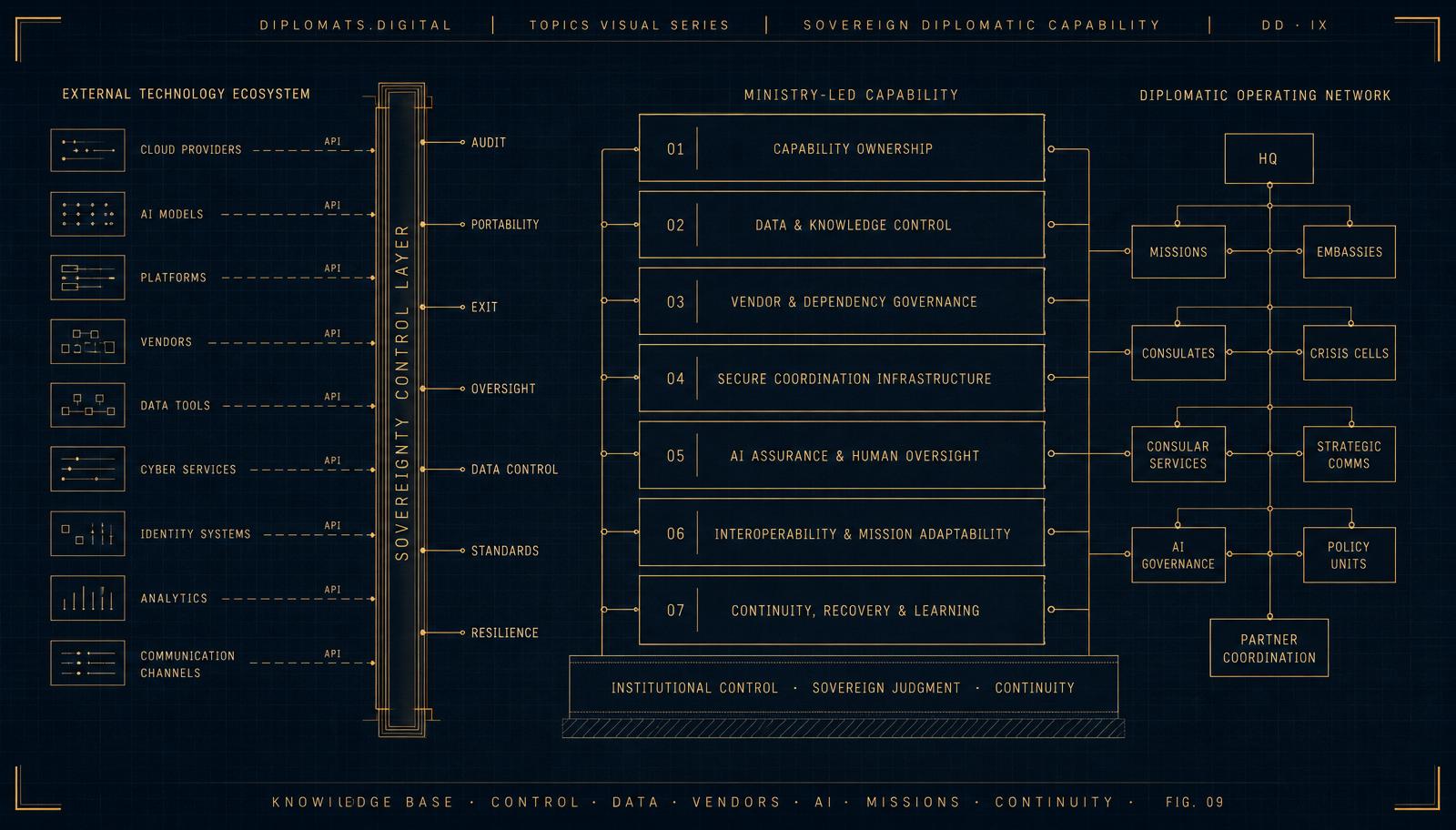
Sovereign diplomatic capability does not mean building everything internally or rejecting external technology partners. It means ensuring that foreign ministries can govern, adapt, audit, recover, and retain institutional control over the digital systems, AI tools, data flows, coordination channels, and mission workflows that increasingly support diplomatic action.
Sovereignty is not isolation
Digital sovereignty is often misunderstood.
It can sound like a call to disconnect from global technology markets, reject external providers, or build national alternatives for everything.
That is not realistic for most foreign ministries. It is also not desirable.
Diplomacy depends on connection. Foreign ministries need global communication tools, interoperable systems, trusted providers, cross-border standards, secure cloud services, AI capabilities, cybersecurity expertise, crisis platforms, and external technical knowledge.
The question is not whether ministries should work with external technology partners.
They already do, and they will continue to.
The question is whether those partnerships strengthen or weaken the ministry’s ability to act as a sovereign institution.
The European Commission’s Sovereign Cloud Framework describes sovereignty in cloud procurement through objectives linked to security, compliance, values-based adoption, resilience, and public-sector control. France’s Ministry for Europe and Foreign Affairs similarly frames digital transformation around sovereign missions, secure trade and data, influence, crisis management applications, and services for citizens abroad.
For foreign ministries, this logic becomes very practical:
Can the ministry govern the systems it relies on?
Can it change provider if needed?
Can it recover during disruption?
Can it protect sensitive diplomatic data?
Can it audit AI-assisted outputs?
Can it preserve institutional knowledge?
Can it adapt tools to local mission realities?
Can it explain who is accountable when digital systems affect diplomatic action?
Sovereignty is not ownership of everything.
It is governability of what matters.
Why capability matters more than tools
The easiest version of digital transformation is tool adoption.
A ministry buys a platform.
A team launches a dashboard.
A unit adopts an AI assistant.
A mission uses a social listening tool.
A consular service deploys a new interface.
A crisis team creates a secure channel.
A communications team monitors online narratives.
Each tool may be useful.
But tools do not automatically become institutional capability.
A tool becomes capability only when it is connected to people, governance, workflows, training, oversight, continuity, and decision-making.
The OECD’s work on digital public infrastructure is useful here because it defines DPI as shared, secure, and interoperable digital systems that support services at scale and reduce duplication across government. The lesson for diplomacy is not that every ministry needs national-scale DPI for foreign affairs. The lesson is that digital capability should be built as shared institutional infrastructure, not as isolated project activity.
A foreign ministry can have many tools and still be institutionally fragmented.
It can also have fewer tools but stronger capability if those tools are well-governed, interoperable, trusted, and embedded in real workflows.
The maturity question is therefore not:
How many digital systems do we have?
It is:
Which institutional capabilities do those systems actually strengthen?
The hidden risk of fragmented digitalization
Fragmentation is one of the quietest risks in diplomatic modernization.
It rarely appears as a crisis at first.
It appears as a series of reasonable decisions.
One team buys a monitoring tool.
Another uses a different analytics provider.
A mission creates its own workaround.
A crisis unit relies on messaging groups.
A consular team uses a separate database.
A policy unit stores knowledge in shared drives.
A communications team keeps approval flows in email.
An AI tool is tested informally by individual officers.
A vendor becomes indispensable because no internal alternative exists.
None of this is necessarily irresponsible.
Often, it reflects necessity. Ministries are under pressure, budgets are limited, crises move quickly, and teams need practical solutions.
But over time, fragmented digitalization can produce institutional dependency.
The ministry may lose visibility over what tools are being used.
Data may become hard to retrieve.
Workflows may become impossible to audit.
AI use may spread without governance.
Missions may operate with different standards.
Knowledge may remain trapped in platforms, inboxes, or individuals.
Vendor decisions may become harder to reverse.
The risk is not that ministries use external systems.
The risk is that the institution no longer knows where its operational capability actually lives.
Three types of dependency
Sovereign diplomatic capability requires a more precise vocabulary for dependency.
Not all dependency is the same.
01 · Vendor dependency
This occurs when a ministry becomes too reliant on one provider for a critical function, especially when data portability, exit planning, audit rights, contractual transparency, or continuity protections are weak.
Vendor dependency is not always visible at the start. It often appears later, when switching becomes difficult.
02 · Workflow dependency
This occurs when the way work is done becomes shaped by a tool rather than by diplomatic purpose.
A dashboard may define what leadership sees.
A platform may determine what counts as relevant.
An approval tool may slow down crisis response.
A vendor interface may reshape how missions report.
A social listening tool may privilege measurable signals over diplomatic judgment.
Workflow dependency is subtle because it looks like efficiency.
But if the tool begins to define the work, the ministry may lose control over its own operating logic.
03 · Model dependency
This is increasingly important in the AI era.
Model dependency occurs when foreign ministries rely on AI systems whose training data, assumptions, limitations, security posture, jurisdictional exposure, update cycles, and output behavior are not sufficiently understood or governed.
The OECD identifies governance, data, digital infrastructure, skills, investment, procurement, and partnerships as core enablers for trustworthy AI in government. The Council of Europe’s Framework Convention on Artificial Intelligence also anchors AI governance in human rights, democracy, and the rule of law across the lifecycle of AI systems.
For diplomacy, model dependency is not only a technical problem.
It is a judgment problem.
If AI summarizes diplomatic reporting, suggests response options, classifies public sentiment, translates sensitive language, or assists crisis triage, then the ministry must understand how human oversight, source reliability, bias, confidentiality, and accountability are managed.
AI and the sovereignty of judgment
AI in foreign affairs introduces a new kind of sovereignty question.
Not only: Where is the data stored?
Not only: Who owns the infrastructure?
Not only: Which vendor provides the tool?
But also:
Who shapes the interpretation?
Diplomacy depends on judgment. That judgment is built from context, history, nuance, language, political sensitivity, legal constraints, human relationships, institutional memory, and national interest.
AI can support that work.
It can help summarize, translate, search, classify, draft, compare, detect, retrieve, and organize.
But it should not silently become the layer through which diplomatic reality is interpreted.
The EU AI Act entered into force in August 2024 and uses a risk-based approach, including transparency requirements for certain AI-generated content and deepfakes. The UN Global Digital Compact also recognizes the need to identify and mitigate risks from emerging technologies and ensure human oversight.
For foreign ministries, this means AI governance cannot be treated as an IT policy alone.
It is an institutional doctrine issue.
Which AI uses are allowed?
Which are restricted?
Which are prohibited?
Which require human review?
Which require secure environments?
Which require source traceability?
Which are appropriate for public material but not sensitive diplomatic work?
Which outputs can be used in policy analysis, consular triage, crisis communication, or leadership briefing?
A sovereignty-safe AI posture does not block experimentation.
It creates boundaries that make experimentation institutionally safe.
The diplomacy-specific problem
Many digital transformation models are designed for generic public administration.
Foreign ministries are different.
They operate across borders.
They manage confidential relationships.
They serve citizens abroad.
They coordinate missions in very different local environments.
They negotiate in sensitive contexts.
They communicate publicly and privately.
They handle crises under uncertainty.
They represent the state symbolically and operationally.
They rely on locally engaged staff, diplomatic rotations, secure channels, and political trust.
A tool designed for ordinary public-sector productivity may not be suitable for diplomatic work.
A tool designed for corporate communications may not understand diplomatic escalation risk.
A tool designed for domestic citizen services may not work for consular emergencies across jurisdictions.
A generic AI assistant may not be appropriate for sensitive diplomatic context.
A monitoring platform may detect online signals but miss local meaning.
This is why sovereign diplomatic capability must be institutionally aligned.
It must fit the ministry’s legal obligations, security posture, diplomatic culture, mission network, crisis routines, and tolerance for risk.
The purpose is not to make diplomacy more “tech-like.”
The purpose is to make diplomatic institutions more capable under digital conditions. This is where diplomatic technology and Foreign Affairs Innovation intersect: not as add-ons to policy, but as the operating layer beneath it.
External partners are not the problem
A sovereignty-safe approach should not become anti-vendor.
That would be a mistake.
Most foreign ministries will need external partners. They will need cybersecurity companies, cloud providers, AI vendors, digital identity specialists, data governance experts, crisis technology providers, communication platforms, research institutions, advisory partners, and implementation support.
The strongest model is not ministry versus vendor.
It is ministry-led capability with external support.
External partners should strengthen the institution’s ability to govern, not make the institution dependent on them.
This means good partners should support:
- knowledge transfer,
- documentation,
- interoperability,
- exit planning,
- training,
- internal ownership,
- auditability,
- modular architecture,
- sovereign data handling,
- and adaptation to ministry culture.
This is also where a capability-building approach differs from a platform-selling approach.
A platform asks:
Will you adopt our system?
A capability approach asks:
What does your institution need to be able to do — safely, coherently, and sustainably?
That distinction matters. Purpose-built environments such as DiplomatIQ exist to rehearse exactly this kind of capability logic under realistic institutional pressure.
Smaller and mid-sized states need a pragmatic model
Sovereignty-safe capability is especially important for smaller and mid-sized states.
Large states may have bigger budgets, larger technical teams, national cloud strategies, internal AI labs, cyber commands, and stronger procurement leverage.
Smaller and mid-sized states often face a different reality.
They need advanced capability but may not be able to build everything themselves.
They need security but may have limited internal capacity.
They need AI access but cannot fully inspect every model.
They need modern consular systems but cannot sustain large custom platforms.
They need narrative awareness but cannot maintain large monitoring teams.
They need mission coordination but operate with small posts and stretched staff.
This makes dependency risk sharper.
But it also makes modular capability more valuable.
A pragmatic model does not say: build everything internally.
It says:
- define the capability clearly;
- retain ownership of doctrine and governance;
- use external support where useful;
- avoid single-point dependency;
- require portability and auditability;
- train internal owners;
- design for small missions as well as headquarters;
- keep diplomatic judgment inside the institution.
World Bank GovTech work is useful because it treats public-sector digital transformation as a maturity question across core government systems, service delivery, citizen engagement, and enabling conditions. For foreign ministries, a similar maturity logic can help smaller and mid-sized states strengthen capability progressively, without pretending they must immediately build large-scale systems alone.
Stress tests, not failure stories
Sovereign capability becomes visible under stress.
A crisis reveals whether consular systems can scale.
An outage reveals whether workflows can continue.
A vendor change reveals whether data is portable.
A deepfake reveals whether verification routines exist.
A platform shift reveals whether public communication is over-dependent.
A cyber incident reveals whether recovery plans are real.
A staff rotation reveals whether knowledge is institutional or personal.
These are not failure stories.
They are stress tests.
The 2024 CrowdStrike-related outage was not a hostile cyberattack, but CISA described it as a widespread outage affecting Microsoft Windows hosts due to an issue with a CrowdStrike update. For foreign ministries, the broader lesson is that operational resilience must include third-party failure, software update risk, manual fallback, communication continuity, and recovery procedures.
Similarly, ENISA’s public administration threat landscape points to data breaches, data leaks, ransomware, and availability-related threats affecting public administration entities. For diplomatic institutions, this reinforces the need to treat sovereignty as resilience: the ability to continue, recover, and preserve trust when systems are pressured.
What should remain sovereign?
Not every system needs the same level of control.
A public newsletter tool does not require the same controls as a crisis coordination system.
A public website does not require the same controls as classified diplomatic reporting.
A social media analytics tool does not require the same controls as consular identity infrastructure.
A generic AI writing assistant does not require the same controls as an AI system used for sensitive briefing material.
The key is classification.
Foreign ministries need to classify digital capabilities by strategic importance, sensitivity, dependency risk, and continuity requirement.
A practical classification might include:
01 · Public-facing low-sensitivity tools
Useful tools for communication, publication, outreach, and basic analytics.
02 · Operational support tools
Systems that support routine workflows but do not carry highly sensitive diplomatic material.
03 · Mission-critical coordination systems
Tools used for crisis response, mission alignment, consular escalation, leadership briefing, and secure coordination.
04 · Sovereign institutional systems
Capabilities that involve sensitive data, diplomatic judgment, national position, AI governance, identity, secure records, institutional memory, or continuity of diplomatic action.
The stronger the capability, the stronger the governance requirement. This is also where the future MoFA agenda meets sovereignty: institutional readiness depends on which capabilities the ministry has chosen to govern deliberately.
From procurement to capability design
Procurement often asks useful but incomplete questions:
What does the tool cost?
What features does it offer?
Who else uses it?
How fast can it be deployed?
Is it compliant?
Is it secure?
Can it integrate?
Sovereign capability design asks additional questions:
What institutional function does this strengthen?
Who owns the capability after deployment?
What data does it generate?
Can that data be exported?
Can the workflow continue if the vendor fails?
What assumptions does the system encode?
Can missions adapt it to local conditions?
What training is required?
What risks does AI introduce?
What happens when staff rotate?
What is the exit plan?
How will lessons be retained?
This does not make procurement slower for the sake of caution.
It makes procurement more strategic.
A ministry should not only buy tools.
It should design capabilities.
Toward modular sovereign capability
The best model for many foreign ministries is modular.
A modular capability architecture allows ministries to combine internal systems, external tools, national infrastructure, trusted vendors, open standards, secure environments, and mission-specific adaptations.
Modularity matters because foreign ministries are not uniform institutions.
Headquarters has different needs from a small embassy.
A consular crisis has different needs from cultural diplomacy.
A mission in a high-risk information environment has different needs from a low-risk context.
A public diplomacy team has different needs from a cyber diplomacy desk.
A senior leadership briefing has different needs from routine monitoring.
Modular capability allows the ministry to avoid both extremes:
- one rigid central system that does not fit local realities;
- many disconnected tools that create fragmentation.
The goal is a shared institutional logic with adaptable implementation.
This is the sovereignty-safe middle path.
For private briefings or institutional inquiries, contact Diplomats.Digital.