Embassy Digital Transformation: From Online Presence to Mission Capability
From online presence to mission capability.
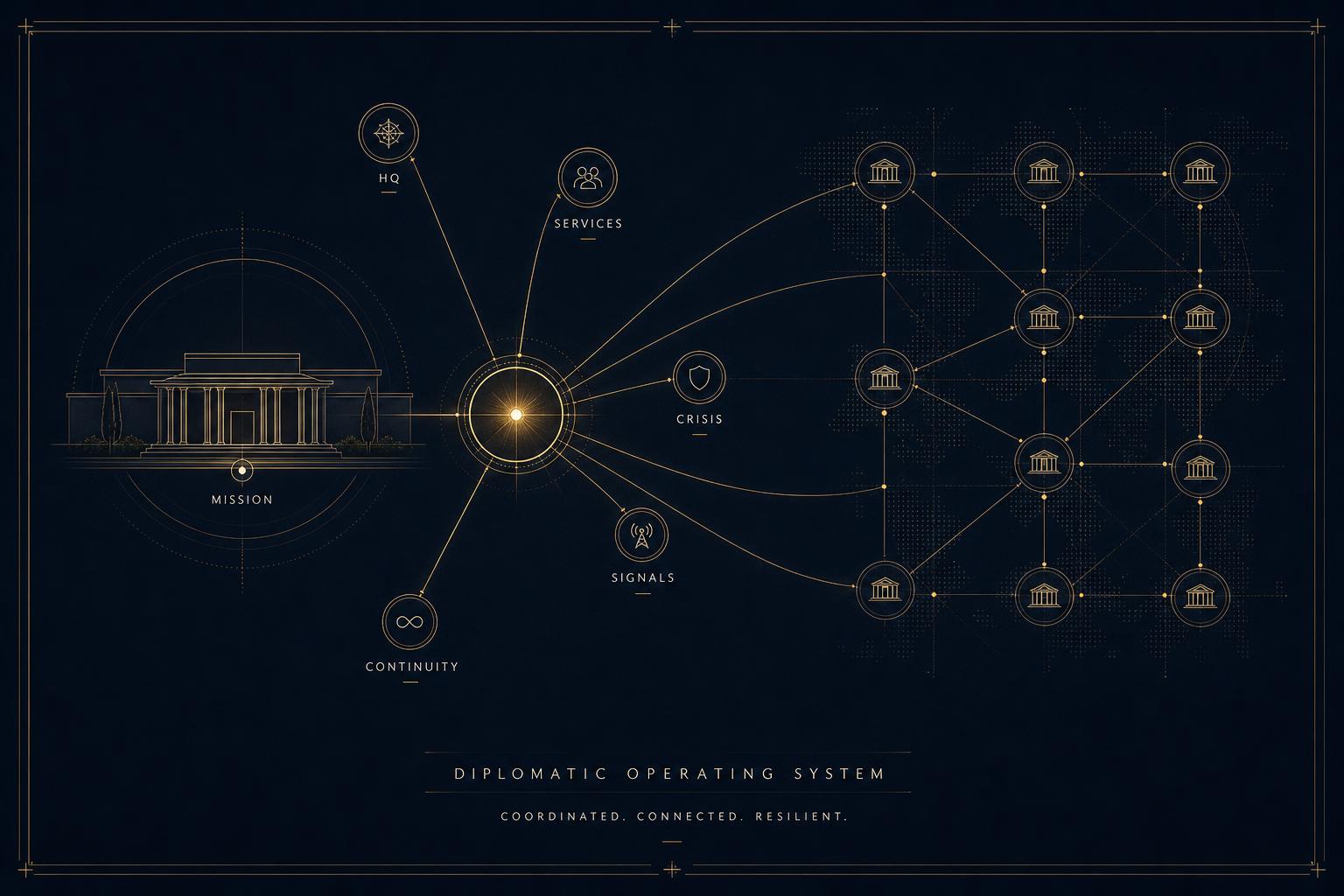
From online presence to mission capability.
For many years, embassy digital transformation was understood in narrow terms: better websites, social media accounts, online appointment systems, digital forms, and more accessible consular information.
Those elements still matter. But they are no longer enough.
The role of an embassy is changing because the environment around diplomacy is changing. Citizens expect faster services. Crises evolve across borders in real time. Host-country narratives shift through digital platforms before official channels can respond. Diaspora communities organize online. Disinformation, influence operations, and reputational risks move across languages and networks. Technology companies shape the public sphere in ways that affect diplomacy directly.
In this environment, the embassy can no longer be treated only as a physical representation abroad. It is becoming a digitally enabled field node.
A modern embassy must be physically present, locally intelligent, digitally connected, service-capable, crisis-ready, and narrative-aware. It must be able to support citizens, represent policy, understand local information environments, coordinate with headquarters, and preserve continuity under pressure.
Embassy digital transformation is therefore not a communications upgrade. It is an institutional capability shift — a core layer of contemporary digital diplomacy.
Why Embassy Digital Transformation Matters Now
The embassy has always been a bridge between the capital and the host country. What is different now is the speed, scale, and visibility of that bridge.
A local issue can become an international story within hours. A consular emergency can generate public pressure before internal reporting is complete. A ministerial visit can be framed by online communities before the official narrative is released. A misleading translation, an edited video, or an anonymous claim can move across platforms faster than traditional diplomatic coordination.
At the same time, citizens abroad expect government services to work with the same ease and responsiveness they experience in other digital environments. They want to access information, register travel, request help, track applications, and receive alerts without navigating fragmented systems.
This creates a new responsibility for Ministries of Foreign Affairs.
Embassies must become part of a wider digital operating system. They need shared standards, secure channels, clear escalation pathways, service platforms, narrative reporting routines, and crisis coordination protocols. The goal is not to replace diplomats with technology. The goal is to strengthen diplomatic judgment, continuity, and coordination through better digital infrastructure.
The future of embassy digital transformation is not virtual diplomacy. It is mission capability.
What Embassy Digital Transformation Is Not
Embassy digital transformation is often misunderstood.
It is not simply having a modern website.
It is not only posting more frequently on social media.
It is not replacing consular officers with chatbots.
It is not outsourcing diplomatic communication to platforms.
It is not turning embassies into marketing offices.
It is not adopting AI because it appears innovative.
These are surface-level interpretations.
A digitally transformed embassy is not defined by how many tools it uses. It is defined by how well its digital systems support diplomatic purpose.
The real question is not: “Is the embassy online?”
The better question is: “Can the embassy operate with clarity, speed, security, and coordination when the environment around it changes?”
This shift matters because digital transformation without institutional design can create new vulnerabilities. A mission can have multiple social channels but no narrative escalation process. It can have digital service forms but no integrated case management. It can have AI tools but weak oversight. It can have excellent local insight but no structured way to transmit it to headquarters.
Digital transformation only becomes strategic when it improves institutional capability.
The Embassy as a Digital Field Node
The most useful way to understand the next phase of embassy transformation is to see the embassy as a digital field node.
A field node is not merely a branch office. It is a connected part of a wider diplomatic system. It senses, serves, reports, responds, and coordinates.
In practical terms, this means that a digitally mature embassy should be able to:
Provide citizens with clear digital access to consular services.
Receive and escalate crisis signals quickly.
Coordinate messaging with headquarters during sensitive moments.
Understand the local information environment.
Detect narrative risks before they become diplomatic problems.
Support public diplomacy with locally relevant content.
Protect sensitive data and communications.
Preserve institutional memory across staff rotations.
Use AI and automation only where they support human judgment.
Maintain continuity when normal operations are disrupted.
This is a different model from the old view of embassy digital presence.
The embassy is no longer only a broadcaster or a service desk. It becomes part of a distributed diplomatic capability network.
What Advanced Examples Show
There is no reliable global ranking of the “most digitally advanced embassies.” The more useful question is which diplomatic systems show advanced embassy-level digital capabilities.
Several examples are instructive.
Estonia’s Data Embassy model shows that diplomatic thinking about “embassy” functions can extend into digital continuity and sovereignty. While it is not an embassy in the traditional diplomatic sense, it shows how states can protect critical digital infrastructure beyond their physical territory while preserving sovereign control.
Denmark’s TechPlomacy model shows how foreign ministries are adapting to the political power of technology companies. Its Tech Ambassador model is not about digitizing a single embassy service. It is about creating a diplomatic mandate around technology, platforms, emerging technologies, and global digital governance.
The United Kingdom’s FCDO consular digital triage algorithmic transparency record shows how AI can support service routing when designed carefully. The value is not that AI replaces consular judgment. The value is that AI can help guide users toward relevant information and reduce pressure on overloaded channels, while preserving human review where needed.
India’s MADAD portal shows the importance of scale in consular transformation. For countries with large diasporas and high volumes of citizen-service demands, digital systems can help structure grievances, tracking, escalation, and resolution across missions.
Canada, New Zealand, and Australia show the importance of travel advice, crisis registration, emergency contact channels, and citizen protection systems. These are not glamorous tools, but they form the backbone of digital consular readiness.
Germany’s Consular Services Portal shows the value of moving administrative services provided by missions into secure online pathways. France, Japan, the UAE, Saudi Arabia, and other states also point toward more integrated visa, attestation, appointment, and service ecosystems.
The Netherlands offers another important lesson: digital transformation is also about network consistency. A diplomatic network becomes easier to trust and navigate when its missions, ambassadors, consulates, and central ministry channels are discoverable, coherent, and clearly connected.
Ukraine’s use of an AI-generated digital person for consular communication shows a frontier case. It should not be copied uncritically, but it demonstrates how wartime pressure, resource constraints, and digital innovation can produce new diplomatic communication formats.
Taken together, these examples suggest that embassy digital transformation is not one thing. It is a set of capabilities.
The Five Layers of Embassy Digital Capability
A serious embassy digital transformation agenda should be built in layers.
1. Digital Access
The first layer is access.
Citizens, residents, businesses, journalists, students, and host-country audiences should be able to find accurate information easily. This includes websites, contact information, emergency numbers, service pages, appointment pathways, travel advice, visa information, and mission updates.
This layer sounds basic, but many diplomatic networks still struggle with inconsistency. Some mission pages are outdated. Some contacts are unclear. Some social accounts are difficult to verify. Some service pathways are split across multiple platforms.
Digital access is the foundation of trust.
If people cannot find the official channel quickly, they will turn to unofficial sources.
2. Digital Services
The second layer is service delivery.
This includes online consular services, appointment systems, case tracking, visa or document workflows, grievance management, registration tools, and citizen assistance platforms.
Digital services reduce friction, but they also create expectations. Once a service moves online, users expect responsiveness, transparency, and continuity. A poorly designed digital service can damage trust as much as an offline delay.
For Ministries of Foreign Affairs, the challenge is to build digital services that are accessible, secure, multilingual where needed, and connected to real operational capacity.
A form is not a service. A chatbot is not a service. A portal is not a service unless it connects to a clear process behind it.
3. Crisis Readiness
The third layer is crisis readiness.
Embassies are often tested during moments of sudden pressure: conflict, evacuation, natural disaster, mass travel disruption, detention, health emergency, cyber incident, or political unrest.
Digital systems can help missions identify affected citizens, send alerts, manage inquiries, coordinate with headquarters, and prioritize cases. But crisis readiness requires more than platforms. It requires rehearsed protocols.
Who sends the alert?
Who updates the travel advice?
Who coordinates with local authorities?
Who handles public messaging?
Who monitors social channels?
Who escalates weak signals to headquarters?
Who records decisions for later review?
The digital embassy must be designed for surge conditions, not only normal operations.
4. Narrative Awareness
The fourth layer is narrative awareness.
A modern embassy operates inside a local information environment. It must understand how the host country sees its government, its policies, its leaders, its alliances, and its crises.
This does not mean that every embassy needs to monitor every online conversation. It means that missions should be able to detect relevant narrative shifts, interpret local context, and report structured insights to headquarters.
Narrative awareness is especially important during geopolitical tension, conflict, elections, major summits, migration pressure, sanctions debates, or public controversies.
A digitally mature embassy should be able to distinguish between criticism, misinformation, manipulation, reputational vulnerability, and escalation risk. It should know when to respond publicly, when to brief privately, when to clarify, when to ignore, and when to escalate.
This connects embassy digital transformation directly to narrative resilience.
5. Institutional Continuity
The fifth layer is continuity.
Embassies experience staff rotations, political changes, local disruptions, leadership transitions, and crisis shocks. Without proper systems, knowledge disappears. Lessons are lost. Contacts become outdated. Digital assets become fragmented. Informal practices replace institutional memory.
Digital transformation should protect continuity.
This means secure knowledge management, structured handovers, shared templates, clear ownership of digital channels, documentation of crisis decisions, updated contact databases, and archives of narrative incidents and public responses.
Continuity is one of the most underestimated dimensions of embassy transformation.
A mission can appear active online while remaining fragile internally. A mature digital embassy preserves knowledge beyond individual staff members.
AI in Embassy Operations: Useful, but Not Sovereign by Default
AI will increasingly enter embassy work. The broader institutional context for this is set out in AI in foreign affairs.
It may help route consular inquiries, summarize local media, translate large volumes of text, identify emerging narratives, draft first versions of routine responses, analyze public sentiment, support travel advice workflows, or organize knowledge from previous incidents.
Used well, AI can reduce administrative pressure and help diplomats focus on judgment.
Used poorly, it can create new risks: inaccurate summaries, biased classification, weak source visibility, overreliance on vendors, data exposure, loss of institutional control, or automated responses in politically sensitive contexts.
For embassies, the question is not whether AI should be used. The question is where it can be used safely.
AI should not become a hidden decision-maker in diplomatic operations. It should be treated as a support layer with human oversight, clear accountability, audit trails, data safeguards, and sensitivity to diplomatic context.
This is especially important because embassies work with sensitive information: citizens in distress, political reporting, local networks, media relationships, internal assessments, and crisis communications.
The strongest AI use cases for embassies will be those that support triage, summarization, translation, pattern recognition, and knowledge retrieval — while keeping final interpretation and diplomatic action in human hands.
The Embassy Digital Transformation Maturity Model
Embassy digital transformation should be assessed by maturity, not by the number of tools deployed.
A simple maturity model can help Ministries of Foreign Affairs identify where their mission network stands.
Level 1 — Digital Presence
The embassy has a website, social media accounts, contact information, and basic service descriptions.
This is the minimum level. It creates visibility, but not necessarily capability.
Key question: Can people find the official mission and understand what it does?
Level 2 — Digital Services
The embassy provides access to online forms, appointment systems, consular services, travel advice, case tracking, or digital document pathways.
This improves user experience, but only if the online interface is connected to operational capacity.
Key question: Can citizens and stakeholders complete meaningful service steps online?
Level 3 — Coordinated Mission Network
The embassy’s digital channels are aligned with headquarters, other missions, and central communication standards. Messaging, service information, crisis updates, and public diplomacy content follow shared guidance while allowing local adaptation.
This is where digital transformation becomes networked.
Key question: Can missions act locally without fragmenting the national position?
Level 4 — Digital Field Intelligence
The embassy does not only publish information. It senses the local environment. It can identify weak signals, narrative shifts, reputational risks, stakeholder concerns, and emerging policy perceptions.
This requires trained staff, reporting templates, local knowledge, and clear escalation channels.
Key question: Can the embassy help headquarters understand what is changing on the ground before it becomes a crisis?
Level 5 — Resilient Digital Embassy
The embassy has integrated service systems, crisis protocols, narrative awareness, secure data practices, AI-assisted support with human oversight, continuity systems, and structured handover processes.
At this level, the embassy becomes a resilient digital field node.
Key question: Can the mission preserve coherence, service delivery, and diplomatic judgment under pressure?
Questions Every MoFA Should Ask
For Ministries of Foreign Affairs, embassy digital transformation should begin with practical questions.
Do all missions have accurate and discoverable official digital channels?
Are embassy websites and social accounts clearly connected to the central ministry?
Can citizens identify legitimate channels during a crisis?
Are digital services connected to real case management and escalation processes?
Do missions have clear protocols for crisis communication?
Can embassies report narrative risks in a structured way?
How are local digital insights transmitted to headquarters?
Who owns digital continuity during staff rotations?
Which AI use cases are allowed, restricted, or prohibited?
Do missions have guidance on vendor tools, data exposure, and information security?
Are lessons from crises preserved across the network?
Can the ministry compare digital readiness across missions?
These questions move the conversation away from appearance and toward capability.
The Risk of Fragmented Transformation
One of the biggest risks in embassy digital transformation is fragmentation.
A ministry may improve its website but leave embassies to manage social channels inconsistently. It may launch a service portal without integrating crisis escalation. It may adopt AI tools without a policy framework. It may ask missions to monitor narratives without giving them a shared reporting format. It may invest in public diplomacy campaigns while neglecting internal coordination.
Fragmented transformation creates the illusion of progress.
The website looks modern. The channels are active. The tools exist. But when a crisis comes, the system still depends on informal coordination, individual memory, and improvised judgment.
This is why embassy transformation must be designed as a network capability, not as a collection of isolated digital upgrades.
From Visibility to Capability
The future embassy will not disappear into the virtual world.
Physical presence will remain essential. Diplomacy still depends on trust, context, relationships, protocol, local knowledge, and human judgment. But physical presence alone is no longer sufficient.
The embassy of the future must be able to operate across physical, digital, informational, and institutional environments at the same time.
It must serve citizens digitally.
It must understand local narratives.
It must coordinate with headquarters quickly.
It must preserve trust during crisis.
It must use technology without losing sovereignty.
It must maintain continuity beyond individual postings.
It must translate local signals into strategic awareness.
Embassy digital transformation is therefore not about becoming more visible.
It is about becoming more capable.
Conclusion
Embassy digital transformation is entering a new phase.
The first phase was presence: websites, social media, contact pages, online visibility.
The second phase was services: portals, appointments, travel advice, registration, digital documents, and case management.
The next phase is capability: digitally enabled missions that can serve, sense, coordinate, respond, and preserve continuity under pressure.
This shift matters for every Ministry of Foreign Affairs.
In a contested information environment, embassies are no longer only representatives abroad. They are part of the state’s digital diplomatic infrastructure. They help protect citizens, interpret local dynamics, support public diplomacy, detect narrative risks, and connect the capital to the world in real time.
The strongest diplomatic networks will not be those with the most digital tools. They will be those that know how to turn digital tools into institutional judgment.
Research References
Selected international examples cited in this guide — presented as illustrative models of embassy-level digital capability, not as a global ranking:
Estonia — Data Embassy / e-Estonia (digital continuity).
Denmark — TechPlomacy / Office of the Tech Ambassador (technology diplomacy).
United Kingdom — FCDO Consular Digital Triage (AI-assisted service triage).
India — MADAD Consular Grievance Portal (consular service management).
Canada — Global Affairs Canada consular services (citizen protection systems).
New Zealand — SafeTravel registration (crisis registration).
Australia — DFAT Smartraveller (travel and consular support).
Germany — Consular Services Portal (integrated digital services).
Netherlands — Netherlands and You (network consistency).
France — France-Visas.
Japan — MOFA eVISA.
UAE — Ministry of Foreign Affairs digital services.
Saudi Arabia — Saudi Visa.
Ukraine — Ministry of Foreign Affairs of Ukraine (wartime digital adaptation).
For private briefings or institutional inquiries, contact Diplomats.Digital.
What Is Digital Diplomacy?
The foundational definition and framework anchoring the Diplomats.Digital knowledge ecosystem.
Read guideAI and Foreign Affairs: Beyond the Hype
How artificial intelligence is reshaping the operating environment of foreign affairs.
Read guideSix Emerging Models of Digital Diplomacy
From public diplomacy platforms and tech ambassadors to AI diplomacy cells — six institutional models of digital capability.
Read guideNarrative Resilience in Foreign Affairs
From message control to institutional judgment — preserving coherence under contested information pressure.
Read guideExplore the knowledge area
Digital Diplomacy
The foundational knowledge area.
Embassy Digital Transformation
Modernising the operating model of diplomatic missions.
Digital Statecraft
Power, sovereignty, and the digital instruments of statecraft.
Strategic Communications
Disciplined ministerial messaging across audiences.