
Digital Diplomacy Is Moving From Communication to Institutional Readiness
A strategic essay on why digital diplomacy is no longer only about communication, visibility, or online presence — and why foreign ministries now need institutional readiness, coordination, judgment, AI safeguards, and capability designed to preserve retained authority.
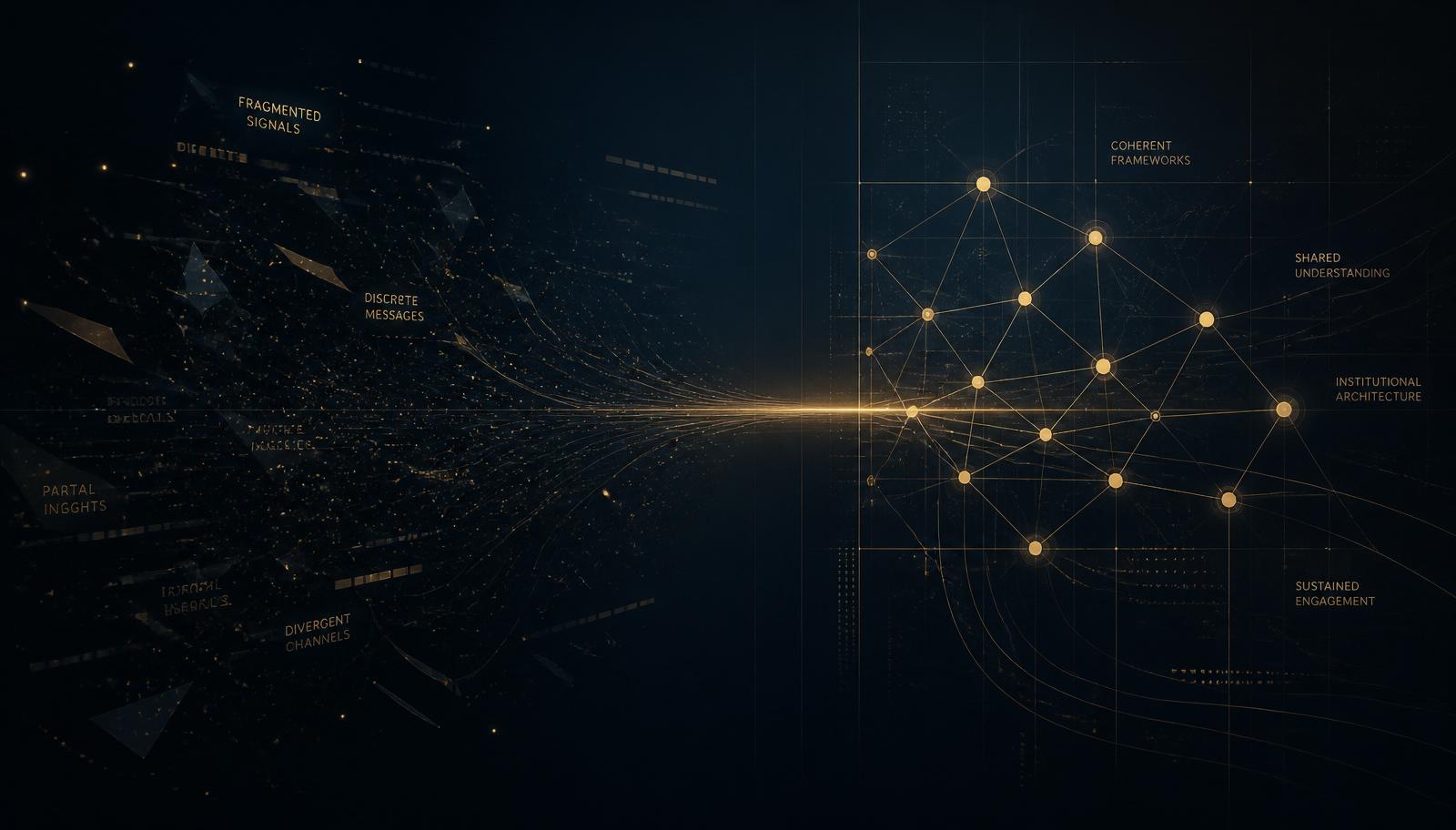
What reading this essay helps you do
- Understand why digital diplomacy is moving beyond communication, visibility, and online presence.
- Distinguish digital activity from institutional readiness, coordination, and diplomatic capability.
- See why every state can strengthen communication while also preparing for AI-era narrative pressure, crisis coordination, and digital capability designed to preserve retained authority.
There are moments when a field changes before its language changes.
Digital diplomacy is now in one of those moments.
For more than a decade, many institutions understood digital diplomacy primarily as a question of communication. Could a ministry be present online? Could an embassy speak directly to foreign publics? Could a diplomat explain policy through social media? Could a government reach audiences faster, more visually, and with less dependence on traditional media?
These were important questions. In many cases, they remain important.
For some states, the immediate task is still to strengthen basic digital communication: clearer embassy messaging, better public diplomacy content, more consistent channels, stronger consular updates, more professional social media use, and greater confidence in speaking to audiences beyond official rooms.
This should not be dismissed. Every state has its own maturity level. Every foreign ministry operates with its own resources, political culture, administrative structure, and diplomatic tradition. Some institutions are still building digital presence. Others already have advanced public diplomacy teams, social listening capacities, crisis communication protocols, or AI policy units.
There is no single maturity model that fits all states. But there is a direction of travel. And that direction is clear: digital diplomacy is moving from communication to institutional readiness.
Communication is necessary, but no longer sufficient
Let us begin with a point that should not be misunderstood. Communication still matters.
Foreign ministries need to communicate clearly. Embassies need to explain policy. Consular teams need to inform citizens. Public diplomacy remains a core part of statecraft. A country that cannot explain itself in the digital environment will increasingly struggle to defend its interests, build trust, correct misperceptions, and participate in global conversations.
So the argument is not that communication is obsolete. The argument is that communication is no longer enough.
A ministry can publish more and still be less prepared. An embassy can be active online and still be isolated from headquarters. A diplomatic network can have hundreds of accounts and still lack a shared understanding of risk. A public diplomacy team can produce good content and still be unprepared when an online narrative becomes politically sensitive, when AI-generated material spreads confusion, or when local pressure around an embassy becomes a strategic issue.
This is the distinction that matters. Digital activity is not the same as digital capability. Visibility is not the same as readiness. Presence is not the same as institutional coordination.
For years, the visible layer of digital diplomacy received the most attention because it was the easiest to see. Posts, campaigns, followers, videos, public statements, hashtags, and engagement metrics created the impression that digital diplomacy could be measured through output.
But diplomacy has never been only about output. Diplomacy is also judgment, timing, restraint, escalation, trust, institutional memory, and the ability to act coherently under pressure. The digital environment has not removed these requirements. It has made them more urgent.
The environment has changed faster than institutions
The deeper shift is not technological alone. It is temporal.
Information now moves faster than traditional diplomatic coordination cycles. A local event can become a regional narrative before a cable is fully processed. A misleading claim can circulate before a mission has verified the facts. A fragmented public conversation can create pressure on a government before the institution has agreed on language, responsibility, or posture.
Artificial intelligence accelerates this further. AI does not simply add another tool to the communications office. It changes the speed, scale, and credibility conditions of the information environment. Synthetic content, automated amplification, machine translation, targeted persuasion, narrative manipulation, and the rapid production of plausible but misleading material all alter the operating context for foreign affairs institutions.
This does not mean every ministry needs to become a technology company. It means every ministry needs to understand that the diplomatic environment is being reshaped by systems that move faster than institutional reflexes.
Here is the core tension: technology evolves exponentially. Institutions usually evolve incrementally.
In an exponential environment, small delays compound. Minor inconsistencies can travel. Local confusion can scale. A weak signal can become a diplomatic issue. A narrative that once remained contained can cross languages, platforms, communities, and borders within hours.
Diplomacy has always operated under uncertainty. But the density and speed of uncertainty have changed. This is why the next phase of digital diplomacy cannot be reduced to better content. The challenge is not only to speak better. It is to sense earlier, coordinate faster, decide more clearly, and respond with discipline.
Digital diplomacy now touches the whole institution
One reason the communication frame is no longer sufficient is that digital diplomacy no longer sits neatly inside communication.
It touches public diplomacy, consular affairs, crisis response, cybersecurity, political analysis, strategic communications, AI governance, information integrity, legal risk, embassy management, leadership communication, and reputation.
A single digital incident can involve several parts of the institution at once. A misleading video may require public clarification, political judgment, technical verification, embassy reporting, platform monitoring, media engagement, and leadership restraint. A crisis affecting citizens abroad may require consular communication, headquarters coordination, local embassy judgment, multilingual updates, and rapid correction of false information. A hostile narrative may require analysis, not simply rebuttal. An AI-generated impersonation may require security protocols, diplomatic notification, internal guidance, and public confidence management.
These situations do not respect organigrams. They move across institutional boundaries.
That is why digital diplomacy is becoming an institutional capability question. The ministry must be able to ask:
- Who sees the signal first?
- Who determines whether it matters?
- Who escalates it?
- Who decides the response?
- Who speaks?
- Who remains silent?
- Who coordinates with missions?
- Who preserves institutional memory afterward?
These are not social media questions. They are governance questions.
Every state has a maturity level, but no state can ignore readiness
This shift must be approached carefully. It would be a mistake to suggest that all states are at the same stage or that every foreign ministry should immediately adopt the same model.
Some states still need to strengthen the communication layer. They may need clearer embassy channels, more consistent messaging, basic digital guidelines, better visual identity, improved crisis updates, or stronger public diplomacy planning. That is legitimate.
But a state can strengthen communication and prepare for institutional readiness at the same time. These are not competing priorities. They are connected stages of the same evolution.
A ministry that is still improving communication can already begin to define escalation pathways. It can already clarify the role of embassies during sensitive online moments. It can already map narrative risks. It can already create simple guidance for AI-generated content. It can already identify which teams need to coordinate when digital pressure rises.
Readiness does not require perfection. It begins with awareness. It begins when an institution stops asking only, “What should we post?” and begins asking, “What must we be prepared to handle?”
That question changes the level of ambition. It moves digital diplomacy from a communications function to a strategic institutional function.
Read the State of Digital Diplomacy 2026 report
A field-mapping and readiness resource for foreign affairs institutions.
Smaller states may have the most to gain
The readiness debate is especially important for small and mid-sized states.
Large powers often have more resources, larger embassy networks, specialized digital teams, intelligence capacities, crisis communication units, and technological infrastructure. They may still have coordination problems, but they often have more institutional depth to absorb pressure.
Small and mid-sized states face a different reality. They may be more exposed to narrative pressure, external influence, capacity gaps, vendor dependency, limited staffing, or fragmented digital practices across missions. They may not have the luxury of building large centralized structures. They need models that are flexible, sovereign, practical, and adapted to their own institutional culture.
For these states, institutional readiness does not mean copying the infrastructure of major powers. It means building the minimum viable capability to act coherently.
That may include:
- a shared vocabulary for digital risk;
- clearer headquarters–mission coordination;
- basic narrative monitoring and escalation thresholds;
- AI-use boundaries;
- crisis communication drills;
- trusted internal channels;
- post-incident learning;
- and leadership-level understanding of digital consequence.
In this sense, readiness is not a luxury. It is a form of diplomatic protection. It helps smaller institutions preserve judgment, sovereignty, and credibility in an environment where visibility can quickly become vulnerability.
Sovereignty is part of readiness
A foreign ministry does not operate like a private company. Its digital systems, data, processes, relationships, and judgments are politically sensitive. Its communication has national meaning. Its mistakes can create diplomatic cost. Its dependencies can create strategic exposure.
This is why the future of digital diplomacy cannot be built only around tools. Tools matter. Platforms matter. AI systems matter. Data systems matter. But the deeper question is: who controls the institutional logic?
An institutionally controlled approach to digital diplomacy means that each ministry preserves control over its own processes, data, political context, decision-making culture, and operational boundaries.
External support can help. Frameworks can help. Technology can help. Advisory work — including capability architectures such as DiplomatIQ — can help. But the capability must ultimately strengthen the institution, not replace it.
The aim should not be dependence on a platform. The aim should be institutional confidence.
This is a crucial distinction. Digital diplomacy should not become another area where states are pushed into adopting systems before they understand the governance consequences. It should not create new forms of dependency under the language of foreign affairs innovation.
The stronger path is modular, adaptable, and sovereignty-aware. Each ministry should be able to build readiness in a way that reflects its own diplomatic culture and national interest.
The future belongs to institutions that can learn
The most advanced foreign ministries of the next decade will not simply be those with the most active digital presence. They will be the institutions that learn fastest.
They will know how to study weak signals. They will understand when a narrative is noise and when it is becoming risk. They will distinguish criticism from manipulation, visibility from influence, speed from strategy, and reaction from response. They will not treat every digital moment as a crisis. But they will know when a digital moment can become one.
This requires institutional memory. Many ministries experience digital incidents as isolated episodes. A crisis happens. A response is improvised. A lesson is discussed informally. Then the institution moves on.
Readiness requires something more disciplined: What happened? Who saw it first? Was the escalation path clear? Did missions and headquarters interpret the situation in the same way? Was the public response aligned with diplomatic priorities? Were there delays? Were there contradictions? What should change before the next incident?
This is how institutions mature. Not through visibility alone, but through learning.
From presence to resilience
Digital diplomacy can be understood as a maturity path.
The first level is presence. A ministry and its missions establish official channels. They become visible. They communicate basic information. They enter the digital environment.
The second level is professionalism. Communication becomes more consistent, more strategic, more audience-aware, and more aligned with diplomatic priorities.
The third level is coordination. Headquarters and missions begin to operate with shared guidance, clearer responsibilities, and common standards. Digital work becomes less fragmented.
The fourth level is readiness. The institution prepares for pressure. It defines escalation, narrative resilience, AI-related boundaries, crisis response, and leadership decision points.
The fifth level is resilience. The ministry can adapt, learn, absorb shocks, protect credibility, and maintain coherence across a changing digital environment.
The important point is that these levels do not always move neatly or sequentially. A ministry may be strong in communication but weak in readiness. Another may be cautious publicly but disciplined internally. Another may have advanced tools but poor coordination. Another may have limited resources but strong judgment and clear procedures.
Maturity is not about looking modern. It is about being prepared.
What this means for diplomatic leadership
For diplomatic leadership, the central issue is not whether digital diplomacy should exist. It already exists. The issue is whether it is governed at the right level.
If digital diplomacy is treated only as communication, it will remain reactive. If it is treated as institutional readiness, it becomes strategic.
This does not mean every minister, secretary-general, ambassador, or director must become a digital expert. But leadership must understand the institutional stakes. Digital diplomacy now affects credibility, crisis response, embassy coordination, narrative exposure, consular trust, national reputation, and strategic positioning.
It is no longer enough to ask communications teams to manage the visible surface. Leadership must ask whether the institution has the internal architecture to handle digital consequence. That architecture does not need to be heavy. But it must be clear.
Who is responsible? What are the thresholds? How does information move? How are missions supported? How is AI governed? How are lessons captured? How is sovereignty protected? How is judgment preserved under speed?
These are leadership questions.
The debate we should be having
The debate on digital diplomacy should move beyond enthusiasm and fear. It should not be only about new tools, nor only about disinformation, nor only about social media, nor only about AI.
The deeper debate is about institutional adaptation.
Can foreign ministries evolve fast enough to preserve diplomatic judgment in an environment that rewards speed, emotional reaction, and constant visibility? Can they build digital capability without losing sovereignty? Can they empower embassies without fragmenting the national voice? Can they use AI without outsourcing judgment? Can they respond faster without becoming reactive? Can they remain credible when the information environment becomes more synthetic, more contested, and more difficult to verify?
These are the questions that define the next phase.
From communication to readiness
The first phase of digital diplomacy was about entering the digital space. The next phase is about being institutionally prepared to operate inside it. This is a more demanding task. It is also a more serious one.
Communication asks: What do we say? Readiness asks: How do we know what is happening, who needs to know, who decides, how we coordinate, and how we protect trust?
Communication asks: Are we visible? Readiness asks: Are we coherent?
Communication asks: Can we respond? Readiness asks: Can we respond with judgment?
This is the shift. Digital diplomacy is moving from channels to systems. From activity to capability. From visibility to consequence. From communication to institutional readiness.
The next phase of digital diplomacy will not be defined only by who communicates most visibly. It will be defined by which institutions can understand consequence before it becomes crisis, coordinate before fragmentation becomes visible, and preserve diplomatic judgment when speed becomes the default condition.
Artificial intelligence, narrative pressure, public visibility, and geopolitical competition are no longer separate files on an institutional agenda. They increasingly meet in the same operating environment. For foreign ministries, this means that digital diplomacy can no longer remain only a communication function. It becomes part of institutional readiness.
Each state will move from a different starting point. Some will still need to strengthen the basics of digital communication. Others will need to refine crisis coordination, AI safeguards, narrative analysis, or mission alignment. But the direction is shared.
Digital diplomacy is becoming a test of institutional maturity: the capacity to act with coherence, restraint, speed, and sovereignty in an environment where visibility can quickly become consequence.
That is why the real transition is not from offline diplomacy to online diplomacy. It is from communication as presence to readiness as diplomatic capacity.
Sources and further reading: digital diplomacy, AI acceleration, and institutional readiness
- Brian Hocking and Jan Melissen, “Diplomacy in the Digital Age,” Clingendael, 2015.
- Ilan Manor, “The Digitalization of Diplomacy: Toward Clarification of a Fractured Terminology,” Oxford Digital Diplomacy Research Group Working Paper, 2018.
- Elsa Hedling and Niklas Bremberg, “Practice Approaches to the Digital Transformations of Diplomacy,” International Studies Review, 2021.
- Corneliu Bjola and Ilan Manor, eds., The Oxford Handbook of Digital Diplomacy, Oxford University Press, 2024.
- Ray Kurzweil, “The Law of Accelerating Returns.”
- Stanford Institute for Human-Centered Artificial Intelligence, “The 2026 AI Index Report.”
- Ilan Manor, “From digital diplomacy to AI-driven diplomacies? Mapping the potential impact of AI on Diplomacy,” Communication and the Public, 2026.
- Corneliu Bjola, “Artificial Intelligence and Diplomatic Crisis Management,” Oxford Digital Diplomacy Research Group Working Paper, 2022.
- United Nations, “Global Principles for Information Integrity,” 2024.
- United Nations, “Global Digital Compact,” 2024.
- UNESCO, “Recommendation on the Ethics of Artificial Intelligence.”
- European External Action Service, “4th EEAS Annual Report on Foreign Information Manipulation and Interference Threats,” 2026.
For private briefings or institutional inquiries, contact Diplomats.Digital.